
How Do You Record Poker Hands at a Live Table?
Record only the hands that put you to a real decision, in shorthand, right after the pot or at a break: stakes, effective stacks, position, your cards, the board, the action with sizes, what you knew about the villain, and how you felt. Thirty seconds of notes is enough; you rebuild the full hand later, away from the table.
Disclosure: OctoCoach is our product. The method below works with any tool, including a notebook; the specific flows described are how OctoCoach implements them.
TL;DR
- Live poker has no hand history, so the hands you do not write down are gone by the next morning.
- Record the hands that hurt, the close decisions, the ones you are not sure about, and every hand that set off tilt or that you played on tilt. Not every hand.
- Write a five-line shorthand: stakes and stacks, positions and cards, the action street by street with sizes, the read, and how you felt.
- Write it right after the pot, while the dealer pushes it, or at a break. Never during a hand. Right after a hand that tilts you, writing it down is also a thirty-second circuit breaker.
- Turn the shorthand into a full hand later, then review it, share it for feedback, or have it analyzed.
Which hands should you record at a live game?
The hands you would want to ask someone about: big pots, close calls and folds, spots where you did not know what to do, hands against players you will meet again, and any hand that set off tilt or that you played on tilt. A session usually has two to five of them. Recording every hand is impossible at a live table, and it buries the few that teach you something.
Memory is the problem live players do not see. By the next day, a big pot shrinks to “I had top pair and he had a set”, and the details that made it a decision (the sizes, the villain’s line, how you felt) are gone. Those details are exactly what a review needs.
Tilt hands deserve their own place on the list, and tilt is not only anger after a bad beat. It shows up after you lose a big pot (anger, the feeling of injustice), after you win one (winner’s tilt: the euphoria that suddenly makes every hand look playable), after a missed value bet or a missed draw (frustration), and after a big mistake you regret the moment you make it (mistake or shame tilt, and the urge to win it straight back). Record the hand that set it off and the hands you played while it lasted; the 8 tilt triggers go deeper into most of them.
| Hand | Why it is worth recording |
|---|---|
| A big pot you lost, or won | The biggest swings deserve a second look either way |
| A close call or fold on the river | The decisions you were least sure about teach the most |
| A spot you did not know how to play | A question to answer before the next session |
| A hand against a regular | Your read on them, while it is fresh |
| A hand that set off tilt: a big loss, a big win, a missed value bet or draw, a mistake you regret | You record the trigger while the feeling is still raw |
| A hand you played on tilt, of any kind | The pattern behind tilt only shows up across several hands |
Our own checklist for live sessions.
What should you write down for each hand?
Five short lines covering the stakes and effective stacks, positions and your cards, the action street by street with the pot and the sizes, what you knew about the villain, and how you felt. Abbreviations are fine as long as you can read them tomorrow.
An example, written in about thirty seconds:
5/10, eff 1,500. Me BTN AhKd. HJ (tight reg) opens 30, I call.
Flop Kc8s3h (75): HJ bets 40, I call.
Turn 2d (155): HJ bets 110, I call.
River 8d (375): HJ jams 1,320, I call. HJ shows 33.
Read: first big river bet I'd seen from him. Felt: stubborn.
That is enough to rebuild the whole hand later. The pot sizes let you check the math, the read records what you knew when you called, and the last line is often the most useful one in review: it tells you whether you played the hand or the hand played you.
Start recording your live hands in OctoCoach (free)
When do you record a hand without missing the next one?
Right after the pot, while the dealer pushes it and shuffles, or at your next break. Five lines take about thirty seconds. Never write during a hand you are in; your attention belongs to the table, and a phone out in the middle of a hand also tells the table something.
Right after a tilt trigger (a big loss, a big win, a big miss or a big blunder), writing the hand down does double duty. It captures your exact mental state while it is still raw, and typing five factual lines forces your brain to slow down for thirty seconds instead of auto-piloting into the next hand on tilt. It is a circuit breaker you already carry in your pocket.
If you are dealt in before you finish, stop, play the hand, and finish the note afterwards. If a session is moving fast, keep only the first line and the river decision, and fill in the rest at the break while the hand is still fresh.
How do you record a hand quickly on your phone?
Use a tracker that takes the hand in whatever form you have it: a few tapped fields, a few typed lines, a dictated sentence, or a photo. OctoCoach’s quick hand log accepts all of them, and with Pro it fills in the fields from your notes or a photo.
In OctoCoach, during an active session you open the quick hand log with the LOG HAND button on the session card, which stays available on a break. You can tap the result, your position, your cards and the board, name the villain (the hand goes onto that player’s profile), mark your mental state, and rate how you played it: A-game, B-game or C-game. The notes field has a Template button that lays out the basic lines (blinds, stack, position, hand), and in a browser that supports speech input, a microphone button that turns what you say into text. Dictate when you step away from the table, on a break, in the hallway or on the walk to the car, so you never talk through your cards and reads within earshot of the table. Logging hands, notes and the self-rating is free.
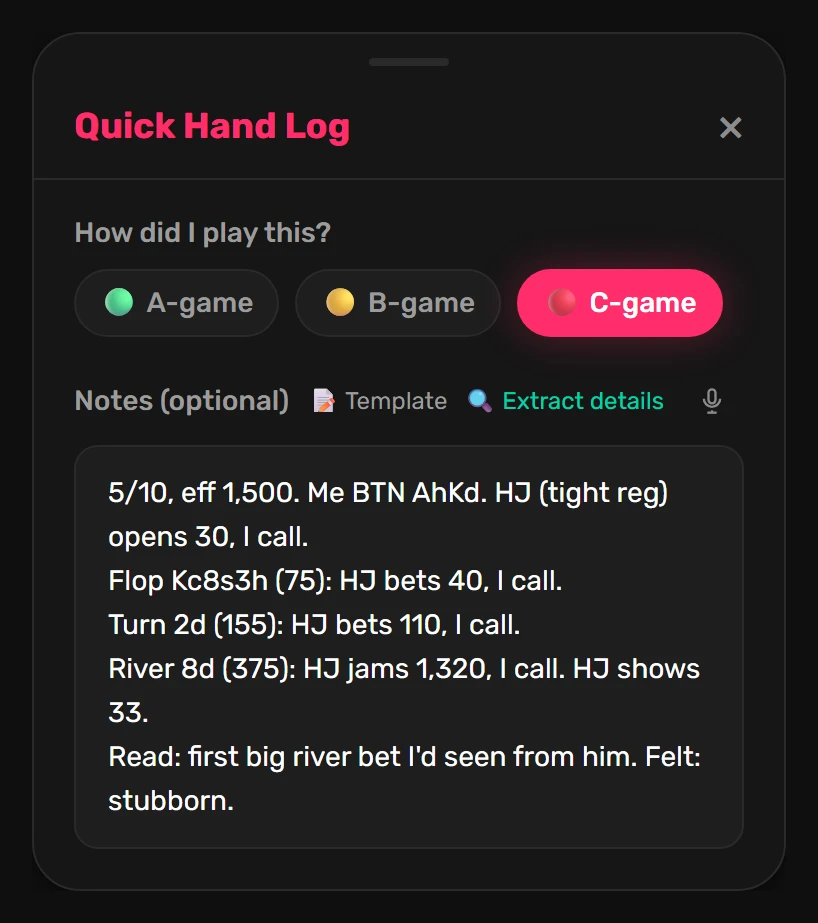
Part of the quick hand log during a live session. The hand in the notes is an example.
With Pro, the Extract details button reads your shorthand and fills in the position, the cards, the board and the action for you, and you can take a photo or upload a screenshot to have the cards and the action read from the image. A hand can also be logged outside a session, so a hand you remember on the way home still has a place to go.
Can you record hands with no signal?
Yes, if the tracker saves to your phone first. In OctoCoach, logging hands, notes and the self-rating works with no connection and syncs when the signal returns. Reading a photo, Extract details and the coach’s analysis need a connection, so you run them once you are back online.
Card rooms and casino floors often have poor reception, which is exactly when a tracker that needs the network fails you. More on what works offline is in how to track a live cash session.
What should you do with the hands you recorded?
Go through them within a day or two, while you still remember the table: rebuild the full action, decide what you would do differently, and get a second opinion on the close ones. A hand you recorded and never looked at again only proves that you were there.
Once a week, go deeper on the three to five that matter most. How to review a poker session has a structure for it. For the hands you are unsure about, ask other players: a replay link or a poll with the decision point gets you real answers instead of a group chat argument, as described in how to get feedback on a poker hand. Your reads on regulars belong with the player, not only with the hand; how to take notes on opponents covers that.
In OctoCoach, the coach (Pro) analyzes a hand by the information you had at each decision, not by the card that came, and says so when a hand was simply a cooler. The A, B and C ratings stay on each hand in History and in the coach’s context, which makes a pattern, such as C-game hands late in long sessions or right after a big loss, easier to spot.
OctoCoach is a coaching and session-journaling tool; it does not host games, take deposits, or involve real money. Logging sessions and hands, the self-rating, replay links and hand polls are free. Pro adds the AI coach, hand analysis, reading hands from photos and text, voice, the bankroll advisor, the shot planner and Mental x Money analytics, for $12/month after a 7-day free trial.
Key takeaways
- Live poker has no hand history: if you do not write the hand down, it is gone.
- Record two to five hands a session: big pots, close decisions, hands you are unsure about, and any hand that set off tilt or that you played on tilt.
- Five lines of shorthand are enough: stacks, cards and positions, action with sizes, the read, how you felt.
- Write right after the pot or at a break, never during a hand; after a tilt trigger, writing it down is itself the pause.
- Review, share and analyze the hands within a day or two, while you still remember the table.
Record your next live session’s key hands in thirty seconds each: OctoCoach, 7 days free, no credit card. Related: how to track a live cash session.