
How Do You Track a Live Poker Cash Session on Your Phone?
Tracking a live cash session means logging four things: the buy-in, every rebuy, your stack a few times during the night, and the cash-out, plus one honest sentence when you stand up. Log on breaks and right after a rebuy, never during a hand. A tracker that takes your stack in chips and keeps working with no signal makes each entry take seconds.
Disclosure: OctoCoach is our product. The checklist below works with any tool, including a notebook; the specific flows described are how OctoCoach implements them.
TL;DR
- Log the buy-in, every rebuy when you take it, your stack a few times per session, and the cash-out.
- Enter your stack in chips and let the app convert it to money.
- Use the phone only at natural pauses: a break, a rebuy, or right after a big pot. During hands it stays in your pocket.
- Set a stop-loss before you sit down, so the decision about the next bullet is made by the calm version of you.
- Card rooms often have weak reception, so use a tracker that saves everything on the phone and syncs later.
What should you track in a live cash session?
Four numbers and one sentence: the buy-in, every rebuy, your stack at a few points during the session, and the cash-out, plus one honest line about how you played. That is enough for an accurate result, an hourly rate, and a record you can learn from, without turning the session into data entry.
Rebuys are the number memory gets wrong most often. A night with four reloads tends to be remembered as two, and a session total that is off by a buy-in quietly breaks every later number: your hourly rate, your bankroll, the stakes you think you can afford. Logging each rebuy when you take it is the one habit that keeps a live record honest.
| What to log | When | Why it matters |
|---|---|---|
| Buy-in and stakes | When you sit down | The baseline every other number is measured from |
| Every rebuy | When you take it | The honest total you put in |
| Stack check-in | On breaks, about once an hour, and right after a rebuy | A live result and a stack chart, beyond the final number |
| Cash-out | When you stand up | The number that settles the session |
| One honest sentence | Before you leave the room | How you played, written before the result colors it |
Our own checklist: a practical minimum for one live cash session.
Log your next session’s buy-in and rebuys in OctoCoach (free)
When should you log during a live game without missing hands?
At natural pauses only: on a break, when you take a rebuy, or right after a big pot while the dealer pushes chips. Each entry takes a few seconds, so there is no reason to touch the phone during a hand. The best trackers ask at the right moment, so you do not have to remember.
In OctoCoach, every full hour of session time brings a short check-in: how you are feeling right now (good and focused, want to talk it through, or feeling tilt), and in a cash game an optional stack update in chips. The hours are counted from when the session actually started. If the phone was in your pocket when an hour passed, the check-in appears when you are back on the Home screen, with the real time you have been playing. If the app is left open on the Home screen and you allow notifications, a silent notification also nudges you, and the check-in waits in the app until your next break.
The coach (Pro) follows the same rule. In-session check-ins are a breather at the right moment, not screen time. When you open the coach on a break, it already knows what changed since you last talked (your stack, your rebuys, how long you have been playing), so the conversation starts where you are.
How do you track your stack during a live cash game?
Count your chips the way you would at the table and type that number. OctoCoach takes the stack in chips worth one small blind each, so you enter a raw count, the money value appears right under the field as you type, and each check-in adds a point to a stack-over-time chart.
Why chips instead of money? At the table you count stacks, not dollars, and doing multiplication in your head mid-session is where mistakes creep in. In a casino 1/2 game each unit is worth 1, so the count is simply your stack (a red $5 chip counts as 5). In a home game or club where the base chip is worth the small blind, say a $5 chip at 5/10, you type the 300 chips you counted and the app shows $1,500 under the field. You count, the app converts.
When you sit down, the app also shows your starting stack in big blinds and chips, worked out from the buy-in. Each stack check-in after that gives you a live result during the session. The stack chart marks your rebuys at the next check-in, so a night that went down, reloaded, and came back reads as a story.
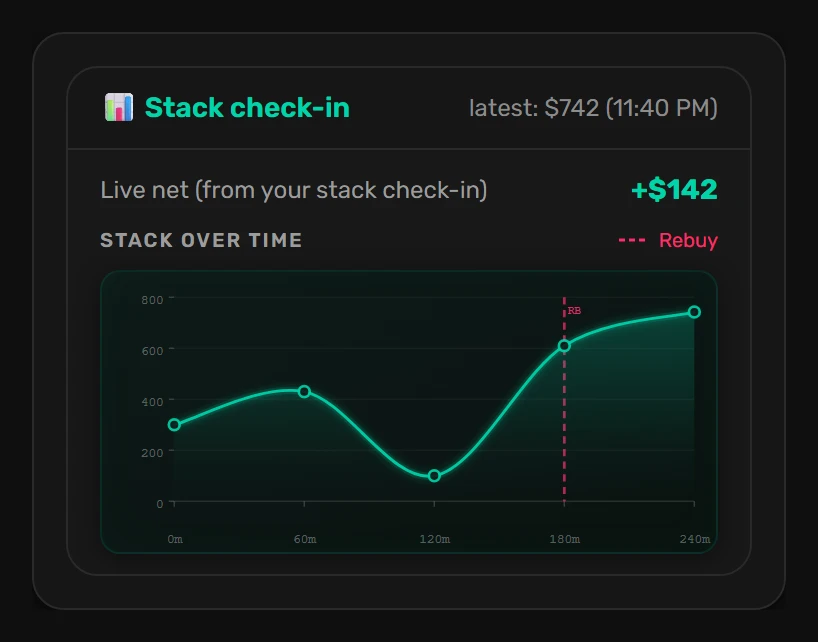
The stack check-in card in a live cash session. Sample numbers: a $300 buy-in, a dip to $100, one $300 rebuy, and $742 four hours in, which is +$142 net, not +$442.
One practical detail: after a rebuy, your live result counts the rebuy as money down until your next stack check-in, so it is worth logging your stack right after you reload. In online sessions, or with several tables at different blinds, the stack is entered in money, because there is no single chip unit.
Does a poker tracker work in a casino with no signal?
Only if it saves to your phone first. Card rooms, casino floors, and basements often have poor reception. OctoCoach keeps working offline after you have signed in once on the device: you can start and end sessions, log rebuys, stack check-ins and hands, and the stop-loss meter keeps counting. Everything is saved on the phone and syncs by itself when the connection returns.
| Works with no signal | Needs a connection |
|---|---|
| Starting and ending cash and tournament sessions | The AI coach chat and voice |
| Rebuys, re-entries, and stack check-ins | Hand analysis and reading hands from screenshots |
| Logging hands, notes, and tilt moments | Sharing hands or sessions |
| The stop-loss meter and a trip budget (one budget for a whole trip or series) | Subscriptions and checkout |
| History, analytics, and your bankroll | Deleting your account |
OctoCoach’s offline mode as of October 2026.
A slim bar at the top shows that you are offline and how many changes are waiting to sync. If a session ends while you are offline, the coach debrief simply waits: when you are back online, a card on the Home screen offers to go over the session.
How do you set a rebuy limit for a live cash game?
Decide the limit before you sit down, and let the tracker hold you to it. Set a session stop-loss, the most you are willing to put in that night, and OctoCoach warns you as you approach it and asks you to confirm before any rebuy that would reach it. It never blocks you; it makes the next bullet a decision you make on purpose.
You can measure the limit as money put in (the default) or as actual net loss, which uses your stack check-ins. The reason to set it at home is simple: the version of you deciding about a fifth rebuy at 2 a.m. is not the version you want making that call. How to pick the number is covered in how to set a poker stop-loss, and what the late-night reload usually costs is in chasing losses in poker.
There is a second, softer guard. If your bullet count runs well above your own usual for that format (in cash, at least two over your average, and never before the fourth bullet), OctoCoach shows a gentle check-in (“That’s a lot of bullets”) once per session, and you can take it to the coach. It is curious rather than accusatory, it only appears once you have at least five past sessions of that format for a real baseline, and it never labels you as tilted.
What should you do right after a live session?
Write one honest sentence before you leave the room: how you played, separate from how you ran. Then enter the cash-out. That sentence is the most valuable thing you log all night, because once you know the result, it tends to color how you remember the decisions.
In OctoCoach the end-of-session sheet has a field for that note. When the session ends, the coach (Pro) opens the debrief by responding to what you wrote; if you skip the note, it starts from the session data instead. Why the result distorts the memory of a decision is covered in results-oriented thinking, and a structured way to go through the night, including which hands are worth a second look, is in how to review a poker session. For the hands themselves, how to record poker hands at a live table covers what to write down in thirty seconds. Live tournaments have their own tracking needs (bullets, bags, and multi-day runs), covered in live tournament tracking.
OctoCoach is a coaching and session-journaling tool; it does not host games, take deposits, or involve real money. Session, bankroll, and hand tracking are free, including offline mode, stack check-ins, and the stop-loss. Pro adds the AI coach, hand analysis, voice, the bankroll advisor, the shot planner, and Mental x Money analytics, for $12/month after a 7-day free trial.
Key takeaways
- Log four numbers (buy-in, every rebuy, stack check-ins, cash-out) and one honest sentence.
- Touch the phone only at natural pauses: a break, a rebuy, or right after a big pot.
- Enter your stack in chips and let the tracker convert it; check in right after a rebuy.
- Pick a tracker that works offline, because card rooms often have no signal.
- Set the stop-loss at home, so the next-bullet decision is made in advance.
Track your next live session with your stack in chips, every rebuy, and a stop-loss you set at home: OctoCoach, 7 days free, no credit card. Related: a pre-session routine for poker.