
How Do You Track Your Live Poker Hourly Rate?
Add up the net result of every session, winning and losing, and divide it by the total hours you played: that is your hourly rate. Track it in big blinds per hour too, so moving up or down in stakes does not distort it. Then treat it as a range, not a fact: live poker deals about 30 hands an hour, and after 300 hours a player who measured +8 big blinds an hour could still be anywhere from about break-even to +17.
Disclosure: OctoCoach is our product. The method below works with any tracker or a spreadsheet; the screens described are how OctoCoach implements it.
TL;DR
- Hourly rate = total net ÷ total hours. Divide the totals; never average each session’s rate.
- Log every session, the losing ones above all, with its start time, end time, buy-in, rebuys and cash out.
- Track big blinds per hour (BB/hr) next to money per hour, so a change of stakes does not distort it.
- Decide once how you treat long breaks, dealer tips and promotions, and keep that rule.
- Live samples are small: a widely used estimate works out to live swings of about 60 to 95 BB/hr, so even after 1,000 hours your true rate is only known to about ±5 BB/hr.
How do you calculate your live poker hourly rate?
Divide your total net result by your total hours, across all your sessions. Use the totals, not the average of each session’s hourly rate: an average gives a short lucky session the same weight as a long losing one.
An example: four live sessions at 1/2, so the big blind is $2.
| Net | Hours | Session rate | Starting energy |
|---|---|---|---|
| +$400 | 2 | +$200/hr | 8 |
| -$300 | 6 | -$50/hr | 6 |
| +$150 | 3 | +$50/hr | 9 |
| -$50 | 1 | -$50/hr | 5 |
| +$200 total | 12 | +$16.67/hr |
Example data.
The hourly rate is +$200 over 12 hours, about +$17 an hour. The average of the four session rates is +$37.50, more than double, because the two-hour win counts as much as the six-hour loss.
In big blinds, +$200 at 1/2 is 100 big blinds, so the rate is 100 ÷ 12, about +8.3 BB/hr. That figure still means the same thing after a move to 2/5 or back to 1/1; the dollar figure does not.
What counts as time and money?
Time is the clock from when you sit down to when you leave the table. Money is everything you cashed out minus everything you put in, rebuys included. The two mistakes that inflate a live hourly rate most are skipping the losing sessions and forgetting a rebuy.
- Every session counts. The sessions players skip logging are usually the bad ones, or as one PokerNews column puts it, “the missing results tend to be the ones we want to forget” (PokerNews). Every skipped loss pushes the rate up.
- All the money you put in. The buy-in plus every rebuy and top-up. Rebuys are the number memory gets wrong most often; how to track a live cash session has a method for them.
- Time at the table. Count from the moment you sit to the moment you get up. A short walk is part of a live session. A long dinner break is a choice: either always count it, or always leave it out by pausing the clock while you eat.
- Tips and promotions. Dealer tips and high hand bonuses are real money out and in. Keep the poker result pure and record them separately, or count them in; just do not switch between the two.
- Mixed stakes. Money per hour mixes your edge with the size of the game. BB/hr separates them: $40 an hour at 2/5 is 8 BB/hr, while $30 an hour at 1/2 is 15.
How many hours before your hourly rate means anything?
Far more than most players think. A live table deals about 25 to 35 hands an hour, and a widely used estimate works out to swings of about 60 to 95 big blinds per hour in live no-limit hold’em. At that size, a solid +5 BB/hr needs roughly 550 to 1,400 hours before you can say with confidence that it is above zero.
The standard deviation of a game is the size of its normal swings. Primedope’s variance guide puts live no-limit hold’em at 120 to 160 big blinds per 100 hands, which works out to about 60 to 95 per hour at the 25 to 35 hands an hour it gives for a live game. Upswing puts a nine-handed live game at 25 to 30 hands an hour, against 60 to 80 at a full-ring online table (Upswing). The 95% range around a measured rate is the rate plus or minus 1.96 times the standard deviation divided by the square root of the hours. With swings of 80 BB/hr, a round middle of that range:
| Hours | 95% range | If you measured +8 BB/hr, your true rate is |
|---|---|---|
| 100 | ±15.7 BB/hr | -7.7 to +23.7 |
| 300 | ±9.1 BB/hr | -1.1 to +17.1 |
| 500 | ±7.0 BB/hr | +1.0 to +15.0 |
| 1,000 | ±5.0 BB/hr | +3.0 to +13.0 |
| 2,000 | ±3.5 BB/hr | +4.5 to +11.5 |
Our calculation: 1.96 × 80 ÷ √hours. At about 30 hands an hour, 100 hours is roughly 3,000 hands and 2,000 hours roughly 60,000. With swings at the high end (95 BB/hr), every range is about a fifth wider.
For scale, PokerNews estimates an average winning player at $15 to $20 an hour at 1/2 and $25 to $40 at 2/5, roughly 5 to 10 big blinds an hour. A measured +5 BB/hr needs about 550 hours to clear zero if your games swing 60 BB/hr, and about 1,400 if they swing 95. The old rule of thumb that 500 hours is the long run (PokerNews) is the low end of that. If the numbers in the meantime are hard to sit through, how to handle a poker downswing covers the other side of the same math.
Track your live hourly rate in OctoCoach (free)
How do you track your hourly rate on your phone?
Log each session with its start and end time, buy-in, rebuys and cash out, and let the tracker do the division. In OctoCoach, the Analytics tab in History shows your profit per hour with the hours it is based on, your BB per hour for cash games, and a breakdown of both money and hours by location, stakes, game or energy. All of it is free.
In OctoCoach, tapping Break during a session pauses your playing clock, so your hourly rate and BB per hour are calculated on net playing time by default, with no need to split a session for a dinner break. If you prefer to measure your hourly rate against your total time in the room, the “Include breaks in hours” switch on the Analytics tab adds the breaks back in. A session you log afterwards can take its break minutes too. A session logged without a duration is left out of the hourly rate entirely, its money and its hours both, instead of inflating it, and the line under the number tells you how many hours it is based on. If you play in more than one currency, each result is converted into your main currency. Tips and promo winnings are recorded at the end of the session, separately from the poker result, and the “Real net (tips + promo)” switch on the Analytics tab shows your money stats after tips and including promo. BB per hour always stays the pure poker result, and it counts cash sessions whose stakes and duration are both known; the app reads the big blind from the blinds you already typed, such as 1/2 or 5/5/10.
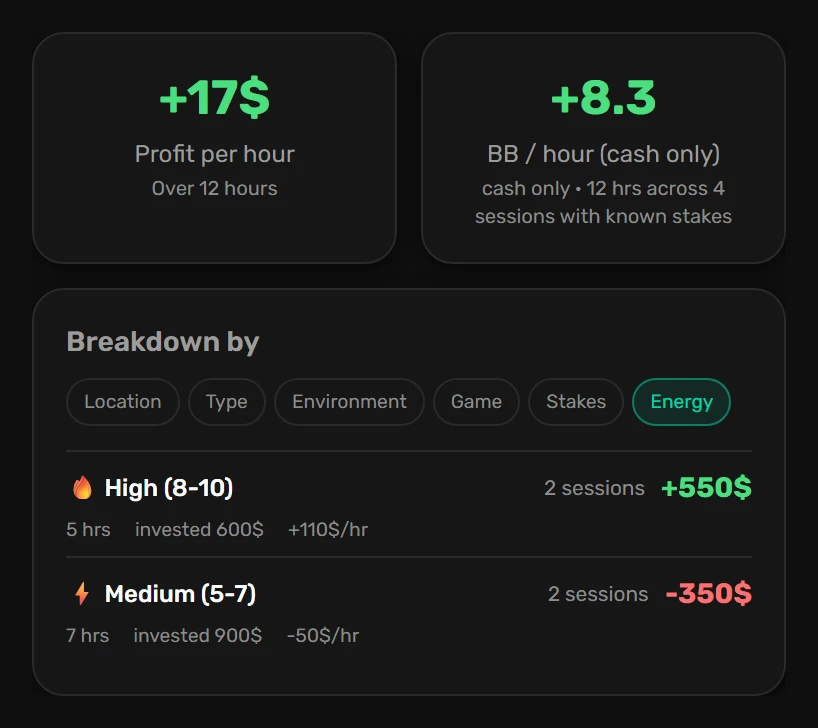
Part of the Analytics tab, with the four example sessions from the table above.
The breakdown groups the same sessions by location, type, environment, game, stakes or energy, plus trip if you use trips, and shows the sessions, net, hours, money invested and profit per hour of each group. In the example, the two sessions that started with high energy made +$110 an hour and the two medium ones lost $50 an hour. With four sessions that gap is noise; with a few hundred hours in each group, it starts to say something about how you play when your energy is down.
What should you do with your hourly rate?
Use it slowly. Compare games and rooms by the hours behind each one before you trust the difference, compare stakes in BB/hr rather than money, and never move up or quit a game on a hundred hours of results.
- Rooms and games. The breakdown shows where your hours go and what they return. A room with 40 hours behind it is a hint, not a verdict.
- Stakes. A higher dollar rate at a bigger game can be a weaker result. Before a move up, see taking a shot in poker.
- Energy. If your low energy sessions keep losing over hundreds of hours, that is a decision you can make before you sit down; poker energy management has the rules.
- Review. The rate tells you what happened, not why. How to review a poker session covers the why.
OctoCoach is a coaching and session-journaling tool; it does not host games, take deposits, or involve real money. Session logging, History with its analytics (profit per hour, BB per hour and the breakdown), hand logging and hand polls are free. Pro adds the AI coach, hand analysis, voice, the bankroll advisor, the shot planner and Mental x Money analytics, for $12/month after a 7-day free trial.
Key takeaways
- Hourly rate = total net ÷ total hours, across every session. Never average session rates.
- Log the losing sessions and every rebuy; those are the two leaks that inflate a live rate most.
- Track BB/hr next to money per hour, so stakes changes do not distort the number.
- With live swings of about 60 to 95 BB/hr, a solid +5 BB/hr needs roughly 550 to 1,400 hours before it clearly says you are a winner.
- Read every slice of the breakdown together with the hours behind it.
Know your real live hourly rate, with the hours behind it: OctoCoach, 7 days free, no credit card. Related: how to track a live cash session.