
How to Handle a Poker Downswing Mentally (Without Wrecking Your Game)
To handle a poker downswing mentally, treat it as variance until your decisions say otherwise: check your play, not your results; shrink your sample expectations to reality; protect your bankroll with a stop-loss and a pre-set move-down rule; and cut volume when your state slips, not when your graph does. A downswing you plan for is a cost. One you react to becomes a disaster.
Every winning player has a stretch where nothing works. The cards go cold, the coolers stack up, and after a few weeks the question changes from “why am I losing?” to “am I actually any good?” That second question is where the real damage starts, because a player who doubts their game starts changing it, and the changes are usually worse than the run.
This guide covers the math of how big a normal downswing gets, how to tell variance from a leak, and the practical rules that let you ride it out with your game and your roll intact.
TL;DR
- A downswing is a stretch of results well below your expected win rate. For a winning player it is normal, not a warning sign.
- Short samples lie. Even a solid winner can easily be behind after 10,000 hands.
- Judge the run by your decisions, not your graph. Review hands with the result hidden.
- Cut volume when your mental state drops, not as punishment for losing.
- Decide your stop-loss and your move-down point while calm, before the run starts.
What is a downswing in poker?
A downswing in poker is a stretch of sessions where your results fall well below what your skill would earn on average, measured from your highest point to your lowest. It is driven mostly by variance: the short-term luck that sits on top of every edge, which can bury a winning player for weeks at a time.
The useful way to measure one is as a drawdown: how far your cumulative results have fallen from their running peak, and over how many sessions. That framing matters because it separates two different questions. “How much did I lose this week?” is noise. “How deep is this dip compared to the ones I have already survived?” is perspective.
What is variance in poker in simple terms?
Variance in poker is the gap between what you should win on average and what you actually win over a given stretch. Your edge only shows up over a large number of hands; in any short sample, the luck of the cards can be many times bigger than your skill advantage.
Poker is a game of small edges realized over huge samples. Getting your money in as an 80 percent favorite means losing one time in five, reliably, forever. Stack enough of those losses close together and you have a downswing, even though every decision was correct. Our guide on how to deal with bad beats covers the single-hand version of this; a downswing is the same math, stretched across weeks.
How long can a poker downswing last?
Much longer than most players expect. Under typical assumptions for a winning online cash player, there is roughly a 29 percent chance of still being behind after 10,000 hands, and around an 11 percent chance after 50,000. Losing months are a normal part of a winning career.
The table below is our own illustration using standard variance math. It assumes a solid winner at 5 big blinds per 100 hands with a standard deviation of 90 big blinds per 100 hands, a common ballpark for no-limit hold’em cash games. One buy-in is 100 big blinds. Your own numbers will differ, but the shape will not.
| Hands played | Roughly in live hours (at ~30 hands/hour) | Expected result | Typical swing (1 standard deviation) | Chance of still being behind |
|---|---|---|---|---|
| 1,000 | ~33 | +0.5 buy-ins | ±2.8 buy-ins | ~43% |
| 10,000 | ~333 | +5 buy-ins | ±9 buy-ins | ~29% |
| 50,000 | ~1,667 | +25 buy-ins | ±20 buy-ins | ~11% |
| 100,000 | ~3,333 | +50 buy-ins | ±28.5 buy-ins | ~4% |
Illustrative probabilities from a normal approximation; “behind” means below break-even at that point. Drawdowns inside the stretch run deeper than the end result.
Two things jump out. First, at live volume, 10,000 hands is several months of regular play, and a real winner is still underwater almost a third of the time. Second, the swings grow with the sample; it is only the expected result that grows faster. That is why one month tells you so little about how well you are playing.
How do you handle a poker downswing mentally?
Handle a downswing by moving your attention from results to decisions: grade the quality of your play, keep your routine stable, separate your self-image from your graph, and remind yourself what a normal downswing looks like before the run tells you a story about your ability.
Losses hit harder than equal-sized wins feel good. Kahneman and Tversky’s prospect theory described this asymmetry, known as loss aversion: losses tend to loom larger than gains of the same size (Kahneman and Tversky, 1979). Over a long downswing that asymmetry piles up, and it pushes players toward the two classic mistakes: chasing (playing longer and bigger to get it back) and flinching (playing scared, folding spots they would normally take).
What helps:
- Grade decisions, not outcomes. For each session, ask “did I play my A-game?” before “did I win?”. A losing session played well is a good session. Our piece on results-oriented thinking in poker breaks down how to do this honestly.
- Keep the routine boring. Same warm-up, same stop-loss, same review. A downswing is the worst time to improvise.
- Write the story down. A short note after each session (“played well, two coolers, no tilt”) turns a blur of losses into a record you can actually read later.
- Separate identity from results. You are a player who makes good decisions and keeps improving. That stays true on the days the cards say otherwise.
Should you play more or less during a downswing?
Play as much as you can play well, and no more. Cut volume when your focus, energy, or emotional control drops, because a tired or frustrated player turns variance into real losses. Do not cut volume just because you are losing, and never add volume to win it back.
The variance math says more hands is how you get out of a downswing: your edge needs a sample to show up. But that only holds if the hands are played at your normal standard. A tilted session does not add to your edge; it subtracts from it.
| Signal | What it usually means | Volume decision |
|---|---|---|
| Losing, but decisions feel clean and focus is good | Variance | Keep your normal schedule |
| Losing, and you catch yourself replaying hands, irritable, rushing | Mental state slipping | Shorter sessions, more breaks |
| Losing, and you want to play longer “to get it back” | Chasing | Stop-loss is non-negotiable; end the session |
| Losing, and you dread sitting down | Confidence dip | Lower stakes or fewer tables until it lifts |
| Losing, and review shows repeated mistakes | Real leak, not just variance | Fewer sessions, more study: log those hands and review them (free) |
The point is that the volume decision follows your state and your decision quality, not the number on the screen.
When should you move down in stakes during a downswing?
Move down when the downswing has eaten into your bankroll past a threshold you set in advance, or when the money at your current stake is affecting your decisions. Moving down is a bankroll and comfort decision, not an admission that you are a bad player.
The worst time to decide whether to move down is in the middle of the run, because by then ego is part of the decision. “Moving down is failure” is exactly the thought that keeps players at a stake their roll cannot carry. Decide the trigger when you are calm, for example a specific number of buy-ins left for your current stake, and treat it as automatic.
A good second trigger is psychological: if you notice you are playing scared at your usual stake, folding spots you know are profitable because the buy-in suddenly feels big, the stake is too high for you right now, whatever the roll says. A step down to where the money stops mattering often brings the A-game back faster than grinding through fear. Our guide on why bankroll management is a mental skill goes deeper on why players resist this move.
How do you know if it is a downswing or you are playing badly?
You find out by reviewing your decisions with the results hidden. If the spots you lost were played correctly given what you knew, it is variance. If you find the same mistakes again and again, you have a leak, and the downswing may be partly earned.
This is the honest question every downswing raises, and the graph cannot answer it. Pick a handful of the biggest losing hands and ask, for each decision, “given what I knew at that moment, was this right?” Get outside reads where you can, without telling people how the hand ended. Look for repetition: one bad call is noise, the same bad call five times is a pattern.
It also helps to check your state. Many “variance” stretches turn out to include sessions played tired, distracted, or tilted. Those are not bad luck, and they are fixable.
How does a stop-loss help during a downswing?
A stop-loss caps the damage of any single session, so a bad run is made of many small losses instead of a few catastrophic ones. It works because the limit is set before the session, by the calm version of you, and does not depend on judgment in the moment.
A downswing is when the urge to “get it back tonight” is strongest, and that urge is how a normal bad run turns into a hole in the bankroll. A typical cash-game starting point is 2 to 3 buy-ins per session. Our full guide to the poker stop-loss covers how to set one and the tactics that make you actually honor it.
Can an app help you get through a downswing?
An app helps most by giving you perspective you cannot hold on to in the moment: a factual view of how deep this run is compared to past ones, a stop-loss that pauses you before you reload, and a coach that already knows your history when you need to talk it through.
That is part of what OctoCoach is built for. In History, the Downswing perspective card (Pro) measures your current drawdown from your own results, deposits and withdrawals excluded, and shows how many past downswings ran at least this deep and the median number of sessions they took to recover. When it is your deepest ever, it says so honestly instead of inventing a precedent. The AI coach sees the same numbers, so when you open a conversation in the middle of a bad run it can talk about your actual dip, not generic “manage variance” advice.
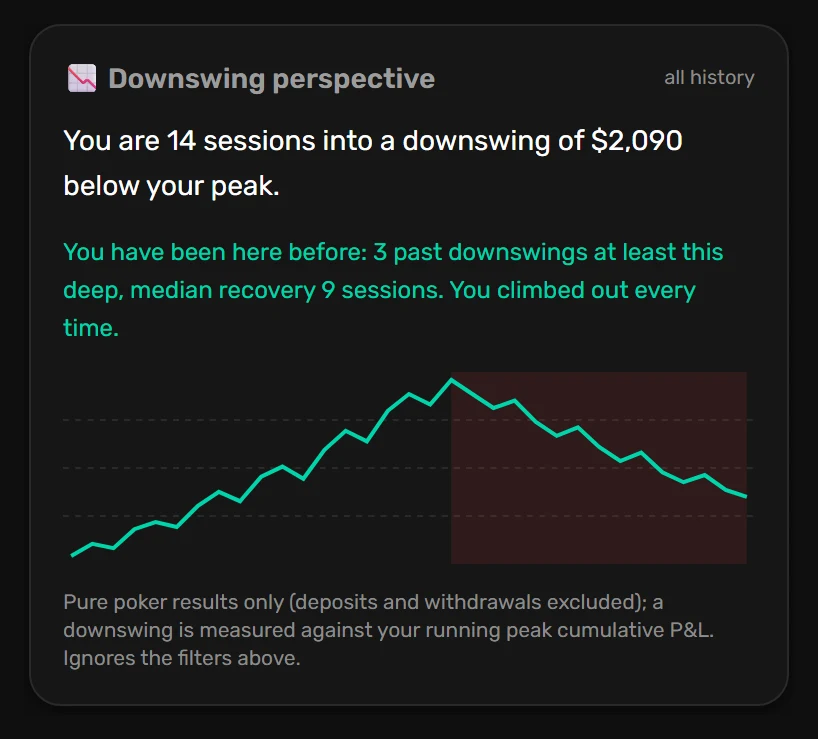
The Downswing perspective card in History (Pro). Sample numbers for illustration; yours are computed from your own sessions.
During play, the optional session stop-loss asks you to confirm before a rebuy that would reach your limit, and if you reload more times than your own usual, a gentle check-in asks what the read is. Never blocking, just a pause. And if the run has you considering a stake change, the shot planner (Pro) lets you set a buy-in budget for a higher stake in advance, with the coach walking you back down when the budget is spent.
Key takeaways
- A downswing is a drawdown from your peak, driven mostly by variance; every winning player has them.
- Short samples lie: under common assumptions, a solid winner is still behind after 10,000 hands roughly 29 percent of the time.
- Judge the run by decisions, not results, and review losing hands with the outcome hidden.
- Let your mental state, not your graph, decide your volume. Never add volume to chase.
- Set your stop-loss and your move-down trigger while calm, and treat both as automatic.
- Moving down is a bankroll and comfort decision, not a verdict on your ability.
A downswing does not tell you how good you are. Your decisions do. Protect the roll, protect your head, keep making good decisions, and let the sample do the rest.
OctoCoach is a mental game coach for the whole session cycle: prepare before you play, check in at breaks, and review afterward with a coach that knows your history. Start free, 7 days, no credit card. Related: poker stop-loss, how to deal with bad beats, and why bankroll management is a mental skill. See also: chasing losses in poker.