
Chasing Losses in Poker: Why "One More Orbit" Costs More Than the Loss
Chasing losses in poker means making decisions to get back to even instead of to play well: staying past your planned end, reloading after your stop-loss, or moving up in stakes to win it back faster. The loss that started it is already gone. The chase is the part you still control, and it is usually played tired, tilted, and at a worse win rate.
Every player knows the moment. It is late, you are down two buy-ins, and the voice in your head says “one more orbit, I just need one good pot.” Sometimes the pot comes. More often the orbit turns into an hour, the hour into another reload, and a bad night becomes a terrible one.
This guide covers what chasing is, why the urge is so strong, how to spot it, what the extra hours actually cost, how to stop, and how chasing differs from a planned move up in stakes.
TL;DR
- Chasing is playing to get back to even: extending the session, reloading past your limit, or moving up to recover faster.
- The urge is normal. Research on decision-making suggests people take more risk when a choice offers a chance to break even.
- The cost is not the loss you already took. It is the extra hours played tired and tilted, often at a bigger stake.
- In our illustration, three extra tired hours a week at 1/2 cost about $2,800 a year compared with playing those same hours fresh, about seven times the $400 loss that started the chase.
- Set a stop-loss and an end time before you sit down, and ask one question when you hit either: “Would I sit down in this game right now, fresh?”
- A planned shot has a budget, a stake, and an exit decided in advance. Chasing has none of the three.
What does chasing losses mean in poker?
Chasing losses in poker means changing how long, how much, or how big you play because you are behind, with the goal of getting back to even. It shows up as staying past your planned end time, rebuying beyond your stop-loss, or moving up in stakes to recover faster. The trigger is the deficit, not the quality of the game.
The key word is “because.” Staying longer is fine when the game is good and you are playing well. Reloading is fine when it is within the limit you set before the session. Moving up is fine when it is a planned shot with a budget. Each of those becomes chasing when the reason is the number on your session result.
Two players can get the exact same cards on the same night and finish very differently: one goes home down two buy-ins, the other, the one we call the Chaser, turns it into five. Same luck, different behavior. The difference is not the cards, it is what happens after the first loss.
Why do poker players chase losses?
Players chase losses because a loss feels bigger than an equal win, and because research suggests people take more risk when a choice offers a chance to break even. Getting back to zero feels like erasing the loss, so the session stops being about good decisions and becomes about a number.
Kahneman and Tversky’s prospect theory described how people tend to weigh a loss more heavily than a gain of the same size, and they noted that someone who has not come to terms with a loss is more likely to accept gambles they would normally turn down (Kahneman and Tversky, 1979).
Thaler and Johnson later tested how earlier gains and losses change later choices. They found what they called a break-even effect: after a loss, gambles that offered a chance to get back to even became especially attractive (Thaler and Johnson, 1990). Their experiments used simple choices between gambles, not poker, so treat this as a useful lens rather than a law of the card room. But it describes the feeling at a table very well. “Down $400” feels like an open wound, “even” feels like it never happened, and a lot of risk starts to look worth it to close the gap.
Poker makes this worse in two ways. First, a session has an arbitrary start and end, so “down for the session” feels like a real result even though it is just a slice of your long-run graph. Second, the game never closes. There is always another hand, and as long as there is another hand, getting even feels possible.
What are the signs you are chasing losses?
The main signs of chasing are staying past your planned end time, reloading after you reach your stop-loss, moving up in stakes to win it back, playing more hands because you want action, checking your session result often, and saying “I just need one pot.” Each one is driven by the deficit rather than by the game.
| Sign | What it looks like at the table | What it costs |
|---|---|---|
| Moving the finish line | ”I’ll leave at 1 a.m.” becomes 3 a.m. because you are still down | Hours played tired, when your edge is smallest |
| Reloading past the limit | Taking another rebuy after you reach the stop-loss you set | Turning a two buy-in night into a four or five buy-in night |
| Moving up to recover | Switching to a bigger game because “it’s faster” | A bigger stake, a tougher pool, and you at your worst |
| Wider ranges | Playing hands you normally fold because you want to win a pot | Lower win rate on every one of those hands |
| Results watching | Counting how far down you are every few hands | Attention that belongs on opponents and spots |
| ”One more orbit” | Promising yourself one more round of the button, again and again | A session with no end except getting even or going broke |
| Staying in a bad game | Staying at a table you would never choose fresh, because that is where the money went | Playing against tougher opponents for no reason except the deficit |
Our own illustration. The rows are common patterns, not a diagnostic test.
If two or three rows sound like your last few late nights, the next step is evidence, not guilt. After each session, write down your planned end time, when you actually left, how many rebuys you took, and whether you were up or down at the moment you decided to stay. Log your sessions with buy-in, rebuys, and length in OctoCoach (free), and after a few weeks you can see whether your long sessions and extra rebuys follow losing nights.
Why does “one more orbit” cost more than the loss?
The loss that started the chase is already spent, and it may have come from good decisions. The chase is new money played at a worse win rate: tired, tilted, often in a worse game or at a bigger stake. Done every week, those extra hours can cost several times the original loss over a year.
Here is the math on one example. It is our own illustration, with assumed win rates, not data from real players. The point is the shape, not the exact numbers.
- You play 1/2 live, so one big blind is $2.
- Fresh and focused, you win about 5 big blinds an hour, so about $10 an hour.
- Tired and chasing, assume you lose about 4 big blinds an hour, so about $8 an hour at 1/2, or $20 an hour at 2/5, where one big blind is $5.
- It is 1 a.m., you are down $400, and you planned to leave now.
| Choice at 1 a.m., down $400 | Extra hours | Assumed win rate | Expected result of the extra hours |
|---|---|---|---|
| Go home as planned | 0 | none | $0 |
| Stay at 1/2, tired and chasing | 3 | minus 4 big blinds an hour ($2 big blind) | minus $24 |
| Move to 2/5 to win it back faster | 3 | minus 4 big blinds an hour ($5 big blind) | minus $60 |
| Play those 3 hours another day, fresh, at 1/2 | 3 | plus 5 big blinds an hour ($2 big blind) | plus $30 |
Our own illustration, before rake and tips. The win rates are assumptions to show the shape, not measured results.
One night looks cheap: $24. The problem is the habit. If you chase for three hours once a week, that is 156 hours a year. At minus $8 an hour that is minus $1,248. The same 156 hours played fresh on other days, at plus $10 an hour, would be plus $1,560. The gap is $2,808 a year, about seven times the $400 loss that started the chase.
And that is only the expected value. The swings get bigger too. At 2/5 a single buy-in of 100 big blinds is $500, more than the whole $400 you were trying to win back, so one bad hand at the bigger stake can double the hole in a few minutes.
There is also a quieter cost: the chase hides the real lesson. A session that ends down $400 at the planned time is easy to review: what happened in the big pots, was it variance or a mistake? A session that ends down $1,000 at 4 a.m. is mostly a review of the chase itself.
How do you stop chasing losses?
To stop chasing losses, decide two limits before you sit down, a stop-loss and an end time, and treat reaching either one as a decision point, not a suggestion. When you hit one, ask: “Would I sit down in this game right now, fresh, with this stack?” If the honest answer is no, leave.
The rules work because you set them when you are calm. Once you are down and tired, you are the worst person to decide whether to keep playing.
- Set a stop-loss before the first hand. A common starting point in cash games is two to three buy-ins for the session. Our guide on how to set a poker stop-loss and stick to it covers how to pick the number for your game and roll.
- Set an end time, too. Losses are not the only trigger. Fatigue is. Pick a time to leave before you start, and write it down where you will see it.
- Use the fresh test. When you reach either limit, ask: “If I walked in right now, rested, would I choose this table, at this stake, at this hour?” If the answer is yes for real reasons (soft game, you feel sharp), staying is a decision. If the only reason is the deficit, it is chasing.
- Have a leaving rule, not a leaving debate. Decide in advance what happens at the limit: you cash out, you go home, no “one more orbit.” The debate is where the chase wins.
- Make the next buy-in slow. Bring only the session’s buy-ins to the casino, or keep only that amount in your online account. A pause before more money gets in gives your calm self a chance to speak.
- Do not count the session result. Your long-run graph matters, a single night’s number does not. Thinking in months instead of nights takes most of the pull out of “getting even.”
If the chase keeps coming back during a run of bad results, the problem may be the downswing rather than the session. How to handle a poker downswing covers how to tell variance from a real problem, and when moving down is the right move.
How is chasing losses different from taking a planned shot?
A planned shot is a move up in stakes with a target stake, a budget in buy-ins, and an exit rule, all decided before the first hand and only when your roll is healthy. Chasing is a move up, or a longer session, decided in the moment because you are behind. The plan is the difference.
From the outside, a player moving from 1/2 to 2/5 looks the same either way. The difference is when and why the decision was made.
| Question | Planned shot | Chasing |
|---|---|---|
| When was it decided? | Before the session, on a calm day | In the middle of a losing session |
| Why move up? | Your results and your roll say you are ready to test it | To win back what you lost faster |
| What is the budget? | A fixed number of buy-ins of the target stake, often 5 | Whatever is in your pocket or your account |
| What is the exit? | Budget used means drop back, no debate | Getting even, or running out of money |
| How do you feel? | Rested, focused, curious about the bigger game | Tired, frustrated, focused on the number |
The rule of thumb: never move up to recover losses. If the bigger game is right for you, it will still be there next week, when you can plan it. Our guide on taking a shot in poker covers how to budget one properly. And if you notice the opposite problem, leaving early or playing tight because the stake feels too big, that is playing with scared money, the quiet flip side of the same coin.
Can an app help you stop chasing losses?
An app helps by holding the limits you set while you were calm and putting them in front of you at the moment you might break them: a stop-loss that asks before the rebuy that reaches it, a check-in when you rebuy more than usual, and a record that shows what long sessions and extra rebuys actually cost you.
That is part of what OctoCoach is built for. Disclosure: OctoCoach is our product; the rest of this article stands on its own without it.
- Before the session. When you start a session, you can set an optional stop-loss (free): the most you are willing to put into the session, buy-in plus all rebuys. In cash games you can choose whether it measures the money you put in or your actual net loss, which uses your stack check-ins and falls back to money put in until you log one. There is also a “What do you want to focus on this session?” field, where you can write your end time or “no chasing” for yourself, and the coach (Pro) keeps it in mind during the session. OctoCoach has no field for a planned end time, so the focus note is where that rule lives.
- At the rebuy. The session card warns you as you get close to the stop-loss, and before a rebuy that would reach it, the app asks you to confirm, so you stop or continue on purpose. It never blocks you. Separately, if you take clearly more rebuys in a session than your own usual count (it needs at least five past sessions of the same format for a baseline), a short check-in appears once that session, and you can take it to the coach (Pro) to talk about what is happening.
- During long sessions. Every full hour of an active session, a short check-in (free) tells you how long you have been playing and asks how you are feeling right now, so the hour you meant to leave does not slip by unnoticed.
- After the session. In History, the Mental x Money card (Pro) crosses your net result against session length (under 2 hours, 2 to 4 hours, over 4 hours) and the number of rebuys, along with mood, energy, and time of day. If your long sessions and your three rebuy nights are where the money goes, you see it in your own numbers.
- If you want to move up, plan it. The shot planner (Pro), in History under the Analytics tab, holds the target stake and the budget in buy-ins before the first hand. During the shot, a live card on the Home screen shows how much of the budget is used, turning yellow at 80 percent and red at 100 percent. Nothing ends the shot automatically, the exit stays your decision.
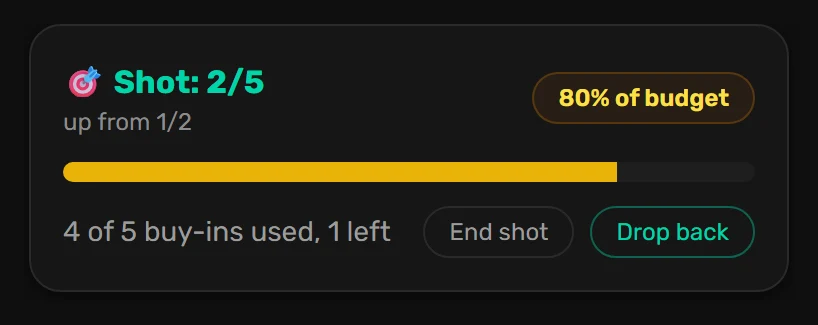
The live shot card on the Home screen (Pro). Sample numbers for illustration.
Key takeaways
- Chasing losses is playing to get back to even: staying longer, reloading past your limit, or moving up to recover faster.
- Research suggests losses feel bigger than equal gains, and that a chance to break even makes risk look more attractive. The urge is normal; acting on it is optional.
- The cost is the chase, not the loss. In our illustration, three tired hours a week at 1/2 cost about $2,800 a year compared with playing those hours fresh, about seven times the original $400 loss.
- At a bigger stake the swings grow too: one 2/5 buy-in is $500, more than the whole deficit.
- Set a stop-loss and an end time before you sit down, use the fresh test at either limit, and follow a leaving rule instead of a leaving debate.
- A planned shot has a stake, a budget, and an exit decided in advance. Never move up to win back losses.
The loss you take tonight is just one point on a long graph. The chase is what turns it into a pattern. Leave on time, and the next session starts from zero anyway.
OctoCoach is a mental game coach for the whole session cycle: prepare before you play, check in at breaks, and review afterward with a coach that knows your history. Start free, 7 days, no credit card. Related: poker stop-loss, taking a shot in poker, playing scared in poker, and how to handle a poker downswing.