
Playing Scared in Poker: What Scared Money Does to Your Decisions and How to Fix It
Playing scared in poker, or playing with scared money, means the money at stake feels too big relative to your bankroll or your real-life finances, so your decisions start protecting the money instead of maximizing expected value. You call where you would raise, fold calls the math supports, drop your bluffs, and leave early to lock up a win. The fix is a stake your roll and your life can absorb, plus in-session resets.
Most players think of mental game problems as tilt: the loud version, where you lose a big pot and start spewing chips. Scared money is the quiet version. Nothing dramatic happens. You just play a little tighter, a little more passively, a little more eager to go home, and every one of those small choices has a price. Because it feels like caution, it rarely gets noticed, let alone reviewed.
This guide covers how to recognize it, why it happens, how much bankroll usually makes it go away, what to do when you catch it mid-session, and how to tell it apart from the disciplined play it imitates.
TL;DR
- Scared money is a stake that feels too big, so you make decisions to avoid losing rather than to win.
- The signs are quiet: passive lines, folding +EV calls, no bluffs, leaving early, and checking your results mid-session.
- It costs real money. Folding a river call you would win a third of the time, getting 3 to 1, throws away about $33 at 1/2.
- The structural cure is a roll of about 30 buy-ins for your stake, built from money that is not needed for life.
- In the moment: think in big blinds, ask “what would I do at my usual stake?”, take a break, and step down if the fear stays.
- Disciplined play follows rules set in advance. Scared play invents new rules in the moment because of the amount.
What is scared money in poker?
Scared money in poker is money you cannot comfortably afford to lose at the stake you are playing, either because it is a large share of your bankroll or because it is needed for life outside poker. It changes your decisions: you start choosing the line that risks the least instead of the one that earns the most.
The term covers two different situations that feel the same at the table. The first is a bankroll problem: you play 1/2 with eight buy-ins, so every stack you lose is a real dent in the roll. The second is a life problem: the roll is technically fine, but it is the same money that pays rent, or it was earned slowly at a job and losing a week’s pay in one hand feels absurd. In both cases the buy-in stops being a tool and becomes something to protect.
That is the core of it. Poker rewards putting money in when the odds are in your favor, even when the outcome is uncertain. A player with scared money is trying to avoid the uncertainty itself, and that is the one thing poker never allows.
What are the signs you are playing scared?
The main signs of playing scared are passive lines with strong hands, folding calls the pot odds support, bluffs disappearing from your game, leaving early to protect a small win, checking your stack and results repeatedly, and translating pots into real-world money. Each one feels like caution, which is why the pattern is easy to miss.
| Sign | What it looks like at the table | What it costs |
|---|---|---|
| Passive value | Calling instead of raising with strong hands, checking back rivers you should bet | Smaller pots when you are ahead, which is where most of your profit comes from |
| Folding +EV calls | Laying down a river call your read and the pot odds both support because “it’s a lot” | The expected value of every correct call you skip |
| No bluffs | Only betting when you have it | Opponents fold less and pay you less, because your range is face-up |
| Hit and run | Leaving after a small win to “lock it up” | Hours in good games you planned to play |
| Results checking | Counting your stack or your session result every few hands | Attention that belongs on opponents and spots |
| Money translation | Thinking “that pot is a car payment” mid-hand | Decisions made by the amount, not the situation |
| Short buy-in | Buying in for less than your usual stack at the same stake | A stack that cannot apply pressure or get full value |
Our own illustration. The rows are common patterns, not a diagnostic test.
If several rows sound like your last few sessions, the useful next step is evidence, not a verdict. Write down, after each session, the stake, how you felt sitting down, and any hand where you chose the line that risked less. Log your sessions with your starting mental state and energy in OctoCoach (free), and after a few weeks you can see whether the pattern follows a specific stake, a specific state, or both.
Why does scared money make you play worse?
Scared money makes you play worse because the pain of a possible loss starts to outweigh the expected gain, so you avoid high-variance lines even when they are profitable. Research on loss aversion suggests losses tend to feel larger than equal gains, and a stake that is too big amplifies that pull.
Kahneman and Tversky’s prospect theory described this asymmetry: people tend to weigh a loss more heavily than a gain of the same size (Kahneman and Tversky, 1979). Their work was about decisions in general, not poker, so treat it as a useful lens rather than a law of the card room. But the pattern it describes is familiar to anyone who has played too big. When a buy-in matters to you, the hand where you lose it looms larger in your mind than the hand where you win the same amount, and you start paying to avoid the first one.
Poker charges for that. Here is the math on a single fold, which is tier-one poker arithmetic, not psychology:
- At 1/2, the pot on the river is $200 and your opponent bets $100.
- You call $100 to win $300 (the $200 pot plus the $100 bet), so the call breaks even if you win 25 percent of the time.
- Your read says this player is bluffing here about one time in three, and your hand beats his bluffs but loses to his value bets, so you win about one time in three.
- Calling earns, on average, (1/3 × $300) minus (2/3 × $100) = $100 minus about $67 = about $33.
- Folding earns $0.
So the scared fold costs about $33 every time this spot comes up, roughly 17 big blinds at 1/2. It does not feel like a loss, because you never see the money leave. That is exactly what makes scared money so expensive: its costs are invisible in the session and only show up in the long-term win rate.
The second cost is predictability. A player who only bets with strong hands is easy to play against. Good regulars notice when someone stops bluffing and stops paying them off, and they adjust within an orbit or two.
How big does your bankroll need to be to stop playing scared?
For cash games, a roll of about 30 buy-ins for your stake, where one buy-in is 100 big blinds, usually makes a single lost stack feel like a normal swing rather than a threat. Below about 15 buy-ins, standard doctrine says move down. And the roll has to be money you do not need for life, or no number will feel safe.
The table below shows what those thresholds mean in dollars on the common ladder. The bands follow standard bankroll doctrine: 30 buy-ins or more is comfortable, 20 is workable, and under 15 is the point where most guides tell you to drop a stake.
| Stake | One buy-in (100bb) | 30 buy-ins (one buy-in is about 3.3% of the roll) | 20 buy-ins (5%) | 15 buy-ins, move-down line (about 6.7%) |
|---|---|---|---|---|
| 0.5/1 | $100 | $3,000 | $2,000 | $1,500 |
| 1/2 | $200 | $6,000 | $4,000 | $3,000 |
| 2/5 | $500 | $15,000 | $10,000 | $7,500 |
| 5/10 | $1,000 | $30,000 | $20,000 | $15,000 |
Our own illustration: standard cash bankroll doctrine applied to the common ladder, before rake, tips, and expenses. Your own numbers may differ.
The share of the roll is what your nervous system reacts to. Losing one buy-in from a 30 buy-in roll costs about 3.3 percent of it, and losing three in a bad night costs 10 percent. Losing one from a 15 buy-in roll costs about 6.7 percent, and three costs 20 percent. The same bad night feels twice as heavy, and it should.
Two honest caveats. First, a big roll does not cure scared money that comes from life pressure. If the roll is also the emergency fund, every buy-in is still rent money, whatever the spreadsheet says. Separate poker money from life money first; our guide on why bankroll management is a mental skill covers how to keep those buckets apart. Second, scared money shows up most at a new stake. If you are moving up on a limited budget, plan it as a bounded experiment, as described in taking a shot in poker, and treat scared play during the shot as a reason to pause it, because a shot played scared does not test your real game.
How do you stop playing scared in the middle of a session?
To stop playing scared mid-session, move your attention from money to decisions: count in big blinds, ask what you would do at your usual stake, decide the next hand on its merits, and take a short break if the fear keeps steering your choices. If it does not lift, ending the session or stepping down is the disciplined move.
None of these remove the feeling. They aim to stop the feeling from making the decision.
- Count in big blinds, not dollars. “I’m calling 50 big blinds” is a poker sentence. “I’m calling $100” is a grocery sentence. Converting back to blinds puts the decision on the same scale as every hand you have studied.
- Run the usual-stake test. Ask: “If this were my normal game, would I make this call, raise, or bluff?” If the answer is yes and you are about to do something else, the amount is deciding, not you.
- Name it. Saying to yourself “this is scared money” is a small act, but it separates the feeling from the read.
- Take a break at a natural pause. Walk away from the table between hands for a few minutes. Look at your plan for the session, not your stack.
- Stop checking the result. Decide in advance that you will not count your stack or your running result until a set break or the end of the session.
- Step down if it stays. If fear is still deciding hands after a break, the stake is too big for you right now, whatever the roll says. Ending the session or playing a smaller game next time is a bankroll decision, not a defeat. If this is happening during a run of losses, how to handle a poker downswing covers when moving down is the right call.
What is the difference between playing scared and playing disciplined?
Disciplined play follows rules you set before the session, such as a stop-loss, a stake limit, or a fold based on a read. Scared play invents a new rule in the moment because of the amount at stake. The test is the reason: if the size of the pot is the reason, it is fear; if the situation is the reason, it is discipline.
From the outside they can look identical. A fold is a fold. Leaving is leaving. The difference is where the decision came from.
| Situation | Disciplined | Scared |
|---|---|---|
| Folding a big river bet | Your read says he is rarely bluffing, so the call does not meet the price | The call meets the price, but the amount feels too big |
| Leaving the session | You hit the stop-loss you set before you sat down, or your focus is gone | You are up a little and want to protect it |
| Not bluffing | The board, the opponent, or your image make the bluff unprofitable | Losing the bluff would hurt too much |
| Staying or moving down | You move down when the roll falls under your line, or when the money starts deciding hands | You stay at a stake that frightens you and play a watered-down game there |
| Small buy-in | You planned a shorter session or a different strategy | You are trying to limit how much you can lose at a stake that feels too big |
The fourth row is the useful twist. Moving down when the money scares you is not playing scared. It is the cure. The scared move is staying put and playing a smaller version of your game at the bigger stake.
When you are not sure which one a decision was, look at it later with the result hidden. A fold that still looks right without knowing what the opponent held was probably discipline. A fold you only defend by pointing at the size of the pot probably was not.
Can an app help you stop playing scared?
An app helps by making the pattern visible and by putting your calm decisions in front of you at the moment you might drift: how you felt before you sat down, whether your roll actually covers the stake, a stop-loss you set in advance, and outside opinions on folds you are not sure about.
That is part of what OctoCoach is built for. Disclosure: OctoCoach is our product; the rest of this article stands on its own without it.
- Before the session. When you start a session, you set your energy on a 1 to 10 scale and pick your mental state, from Focused and Calm to Anxious and Stressed (free). Over time, the Mental x Money card in History (Pro) crosses your net result against mood, energy, and other factors, so you can see whether your losing sessions cluster around a particular state.
- Is the stake right for your roll? The bankroll advisor (Pro), in History under the Analytics tab, reads your own results and gives each cash stake you have enough sessions at a Green, Amber, Red, or Move down verdict, with a Move down alert when your roll falls under 15 buy-ins for the stake you currently play. Green starts at 30 buy-ins, Amber at 20, Red at 15, and Move down is anything under 15, with one buy-in counted as 100 big blinds, the same bands as the table above.
- If poker is entertainment money. In Settings you can set your game plan to Fun budget and enter a monthly poker budget (free). The Home screen then shows how much of this month’s budget your poker has used, and once it is fully used, starting another session asks you to confirm first. It never locks you out. With Pro, the bankroll advisor switches to budget fit: what a typical buy-in at your stake costs against your monthly budget.
- During play. The optional session stop-loss (free) counts everything you put into the session, buy-in plus rebuys. Before a rebuy that would reach the limit, the app asks you to confirm, so you stop or continue on purpose; it never blocks you. Separately, if you take more rebuys in a session than your own usual count (once you have enough past sessions for a baseline), a short check-in appears, and you can take it to the coach (Pro) to talk about what is happening.
- After the session. Not sure whether a fold or a passive check was scared or disciplined? Turn the hand into a hand poll (free): other players see the action up to the decision and vote before they know how the hand ended, and opponent names are masked automatically.
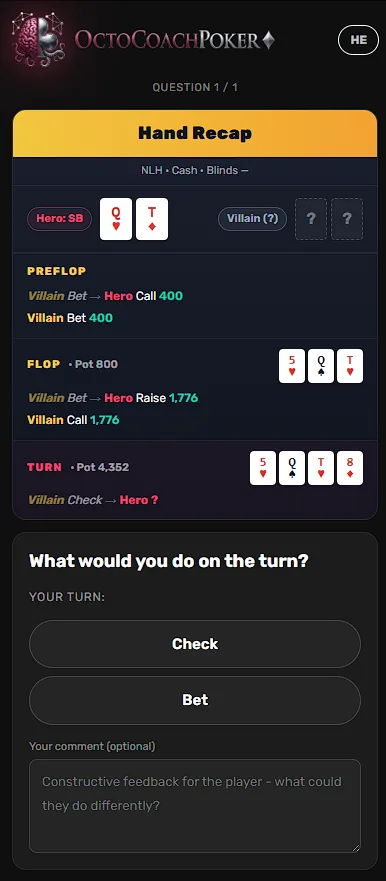
A hand poll in OctoCoach: voters see the action up to the decision and answer before they know the result.
Key takeaways
- Scared money is a stake that feels too big for your roll or your life, so you play to avoid losses instead of to win.
- The signs are quiet: passive value, folded +EV calls, no bluffs, leaving early, results checking, and thinking in rent payments.
- The cost is real but invisible: a scared fold getting 3 to 1 in a spot you win a third of the time gives up about $33 at 1/2, about 17 big blinds.
- About 30 buy-ins for your stake, where a buy-in is about 3.3 percent of the roll, usually removes the bankroll version. The life version needs separate poker money.
- In-session: count in big blinds, run the usual-stake test, take a break, and step down if the fear stays.
- Discipline follows rules set in advance. Fear invents rules in the moment. Moving down because a stake scares you is discipline.
Scared money rarely loses you a big pot. It loses you a little in every spot, quietly, for as long as you keep sitting in a game that is too big. Find the stake where the money stops mattering, and your real game comes back.
OctoCoach is a mental game coach for the whole session cycle: prepare before you play, check in at breaks, and review afterward with a coach that knows your history. Start free, 7 days, no credit card. Related: why bankroll management is a mental skill, taking a shot in poker, and how to handle a poker downswing. See also: chasing losses in poker.