
Taking a Shot in Poker: When to Move Up in Stakes and How to Budget It
Taking a shot in poker means playing one stake above your usual on a fixed budget of buy-ins, typically 5, while keeping a full bankroll (about 30 buy-ins) for the stake you came from. The budget is spent only by net losses at the new stake. When it is gone, you drop back, automatically, and treat it as a cost of information rather than a failure.
Everyone who moves up in stakes does it one of two ways. Either the roll is already big enough for the new stake and the move is permanent, or the roll is not quite there and the player takes a shot: a bounded, pre-planned experiment at the higher game. The second way is fine. Most players who get to mid stakes took shots along the way. The problem is that most shots are not planned; they are taken on a good night, with no budget, no exit rule, and no record. Those are not shots. They are drifts.
This guide covers the difference, the math behind the classic 5 buy-in budget, what should and should not count against it, and the part nobody enjoys: dropping back.
TL;DR
- A shot is a move up on a bounded budget. A permanent move-up is for when the roll already covers the new stake.
- The classic shot budget is 5 buy-ins of the target stake, on top of a full 30 buy-in roll at your current stake.
- Count the budget by net loss only. A winning shot session does not spend it; a losing one does.
- Decide the exit before the first hand: budget gone means drop back, no renegotiation.
- Write the plan down. A shot you cannot state in one sentence is not a plan.
What does taking a shot mean in poker?
Taking a shot is a deliberate, time-boxed attempt to play a higher stake than your bankroll fully supports, with a pre-set cap on how many buy-ins you are willing to lose before returning to your regular game. It is a way to test a bigger game without betting the whole roll on the result.
The key word is bounded. A shot has three parts: a target stake (usually the next rung up), a budget (a number of buy-ins of that stake you can lose), and an exit rule (what happens when the budget is spent). Remove any one of them and you no longer have a shot, you have a player sitting in a game that is too big for them and hoping.
The reason shots exist at all is that bankroll rules are conservative on purpose. Waiting until you have 30 buy-ins for the next stake before you ever play a hand there is safe, but slow, and it tells you nothing about whether you can actually beat that game. A shot buys that information for a fixed price.
When should you move up in stakes?
Move up permanently when your bankroll holds roughly 30 buy-ins for the new stake and your results at the current stake are positive over a real sample. Take a shot when your current roll is full (30 buy-ins at your stake) but short of that target, and you have a clear reason to think your game travels. Never move up to recover losses.
The two decisions look similar and feel very different. The table below is the way we separate them.
| Signal | Shot | Permanent move-up |
|---|---|---|
| Bankroll | Full roll at your current stake, plus a 5 buy-in budget for the target | About 30 buy-ins of the target stake |
| Results | Winning at your stake, but the sample or the roll is not there yet | Winning over a large sample, roll already covers the new game |
| Exit rule | Budget spent: drop back, no debate | Standard move-down rule: under 15 buy-ins for the stake, drop |
| Mindset | Experiment with a fixed cost | New home |
| What you learn | Whether the bigger game is beatable for you right now | Whether you can sustain it over months |
Two honest cautions. First, “winning at your current stake” has to mean something. A hot month is not a sample. Our guide on why bankroll management is a mental skill goes into how players talk themselves into “ready” when the graph is really just variance pointing up. Second, a shot is never the right answer to a downswing. Moving up to win back what you lost below is chasing with extra steps; if that is the itch, read how to handle a poker downswing first.
How many buy-ins do you need to take a shot?
The classic answer is 5 buy-ins of the target stake as the shot budget, on top of a full roll of about 30 buy-ins at your current stake. One buy-in is 100 big blinds. So a shot from 1/2 to 2/5 means a $6,000 roll at 1/2 plus a $2,500 budget for 2/5, about $8,500 in total.
Here is the math laid out on the common online cash ladder. The assumptions: dollar games, a buy-in of 100 big blinds, a shot budget of 5 buy-ins, and a full roll of 30 buy-ins at the stake you are coming from. No rake, tips, or living expenses are included, and your own numbers can differ; the shape is what matters.
| Shot target | One buy-in (100bb) | 5 buy-in shot budget | Full roll at the stake below (30 buy-ins) | Total before the shot |
|---|---|---|---|---|
| 0.5/1 (from 0.25/0.5) | $100 | $500 | $1,500 | $2,000 |
| 1/2 (from 0.5/1) | $200 | $1,000 | $3,000 | $4,000 |
| 2/5 (from 1/2) | $500 | $2,500 | $6,000 | $8,500 |
| 5/10 (from 2/5) | $1,000 | $5,000 | $15,000 | $20,000 |
| 10/20 (from 5/10) | $2,000 | $10,000 | $30,000 | $40,000 |
Our own illustration, standard bankroll doctrine applied to the common ladder. The 1/2 to 2/5 step is a 2.5x jump; every other step here is 2x.
Two things stand out. The first is how big the shot budget is relative to the total roll: at the 2x steps it is 25 percent of everything you have, and at the 1/2 to 2/5 step it is about 29 percent. A shot is not a small bet. That is exactly why the budget has to be real and the exit has to be automatic. The second is that the 1/2 to 2/5 move is the most expensive on the ladder in current-stake terms: a $2,500 budget is 12.5 buy-ins at 1/2, compared with 10 buy-ins for a 2x step. Players feel this one more, and they should.
Why 5 and not 2 or 10? Five buy-ins is enough that a normal bad run at the new stake does not end the experiment on its own (losing two buy-ins in a session of 2/5 is a Tuesday), and small enough that a failed shot sets your roll back weeks, not months. Some players run 3 buy-in shots when the jump is small, or a longer shot when the roll is deep. The number is less important than the fact that it is fixed before the first hand.
How should you budget and track a shot?
Budget a shot by net loss at the target stake only: wins at the new stake refill the budget, losses spend it, and sessions at your regular stake do not touch it. Set a per-session stop-loss inside the shot, and keep a simple written record of every session so the running total is a fact, not a feeling.
The budget rules that make a shot work:
- Net loss, not buy-ins fired. If you buy in for $500 at 2/5, rebuy once, and leave with $1,100, you are up $100 and the budget is untouched. If you leave with $300, you have spent $700, or 1.4 buy-ins of the budget. Counting bullets fired instead of net result makes winning sessions look like losses and ends shots early.
- Only the target stake counts. Your 1/2 sessions in the same week keep feeding the roll underneath. They are not part of the shot ledger.
- A stop-loss inside the shot. The standard cash stop-loss of 2 to 3 buy-ins still applies at the new stake, in the new stake’s buy-ins. Without it, a single tilted night can empty a 5 buy-in budget before the exit rule gets a chance to work. Our full guide to the poker stop-loss covers how to make one stick.
- Treat committed money as at risk while you sit. Mid-session, the honest view of your budget is pessimistic: everything you have on the table could be lost. Plan rebuys against that view, not against the stack you hope to finish with.
Here is the self-check. Right now, without looking anything up, can you say in one sentence what your shot budget is, how much of it is spent, and what happens when it is gone? If the answer is a shrug, you are not taking a shot, you are drifting up a stake. OctoCoach’s shot planner (Pro, 7-day trial) holds that sentence for you: target stake, budget, buy-ins used and left, updated from the sessions you actually log.
When should you end a shot and move back down?
End a shot the moment the budget is spent, and move back to your previous stake without a review of whether “it was really variance”. The exit rule is only worth anything if it fires automatically. Also end it early if you notice yourself playing scared at the new stake, because a shot played scared is not testing your game.
This is where shots go wrong, and it is rarely the math. The plan says 5 buy-ins. The fifth is gone. And a very reasonable voice says: the game was good tonight, I ran under, one more buy-in and I am back in it. Two patterns from decision research are worth knowing here, hedged as research rather than law. Loss aversion, described in Kahneman and Tversky’s prospect theory, suggests losses tend to weigh more than equal gains (Kahneman and Tversky, 1979), which is why “down 5 buy-ins” feels like a hole that must be filled rather than a number that was agreed in advance. And escalation of commitment, studied by Barry Staw, is associated with people investing more in a course of action after negative feedback about it, partly to justify what they have already put in (Staw, 1976). “One more buy-in” is that pattern in a card room.
The defense is structural, not willpower:
- Pre-commit the exit in writing, with the number of buy-ins and the words “then I drop back”. Read it before each shot session.
- Make the drop a neutral action. Moving back to 1/2 after a failed shot at 2/5 is a bankroll decision, the same as sitting down was. No post-mortem is owed at the table; the review happens later, with the result hidden.
- Separate the two exits. A shot can end because the budget is gone (drop back) or because you decided the game is not for you right now or you simply held the stake and are done experimenting (end the shot). Both are legitimate. Only the first one is urgent.
- Watch for scared money. If you are folding spots at 2/5 you would snap-call at 1/2 because the pot feels big, the shot is not giving you clean information. Pause it, rebuild comfort, try again later.
What are the most common shot-taking mistakes?
The common mistakes are taking a shot to recover a downswing, starting without a written budget, counting buy-ins fired instead of net loss, renegotiating the budget once it is spent, and treating a failed shot as a verdict on your ability rather than a data point about your roll and the game.
In a little more detail:
- Shooting during a downswing. The roll is already shrinking; a shot adds a bigger bet on top. Fix the state first.
- No budget, or a budget decided after sitting down. The first hand of the shot is the last moment you are neutral about the number.
- Changing the game as well as the stake. Moving from 6-max online to a live full ring 2/5 at the same time means you cannot tell which change produced the result. One variable at a time.
- Calling it a failure. A shot that loses 5 buy-ins and gets you back to 1/2 intact did exactly what it was for. The alternative was finding out at 2/5 with 30 buy-ins on the line.
- Never reviewing it. Whether it worked or not, a shot produces a few sessions against a tougher pool. Review them honestly; the leaks the bigger game exposed are the real payoff.
Can an app help you plan a shot?
An app helps by holding the plan where you cannot renegotiate it: the target stake, the budget in buy-ins, how much is spent, and a visible exit. It is most useful when it only counts the sessions that belong to the shot, measures the budget by net loss, and does not quietly end the shot for you, so the decision stays yours.
That is how the shot planner in OctoCoach (Pro) works. It lives in History, under the Analytics tab, next to the bankroll advisor. Tap “Plan a shot” and the sheet suggests the next rung above your current stake (you can type any stake instead), lets you pick the currency of the target game, and asks for the buy-in budget, 5 by default, where one buy-in is 100 big blinds of the target. If your roll is under 30 buy-ins at your current stake it shows a warning, because a full current roll is the clean doctrine, but it never blocks you; the choice is yours, eyes open.
From then on, only cash sessions at the target stake and currency that you start while the shot is active count against the budget, and they count by net loss, so a winning session does not burn it. The live meter on the Home screen is deliberately conservative: during a running shot session, everything you have committed (buy-in plus every rebuy) shows as at risk until the session ends, then it settles to the real result. The bar turns yellow at 80 percent of the budget and red at 100 percent. Nothing closes the shot automatically. The card has two buttons, “Drop back” and “End shot”, because the exit decision is the whole point and it should be yours.
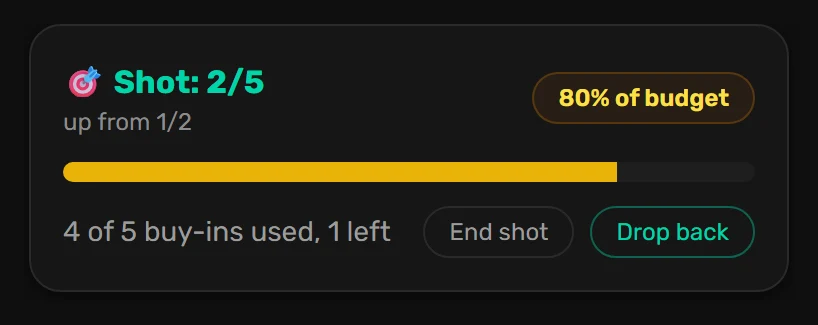
The live shot card on the Home screen. Sample numbers for illustration.
The coach sees the shot too: the target stake, the budget, and how many buy-ins are used and left. While the budget holds, it supports the plan and your normal game at the higher stake. When the budget is gone, it accompanies the drop back as smart discipline and offers a short review of how the shot went. It never pushes you to keep firing. Disclosure: OctoCoach is our product; the rest of this article stands on its own without it.
Key takeaways
- A shot is a move up on a fixed budget of buy-ins with a pre-set exit. A permanent move-up waits for about 30 buy-ins of the new stake.
- The classic budget is 5 buy-ins of the target, on top of a full roll at your current stake. At 2x stake jumps that budget is 25 percent of your total roll; at the 1/2 to 2/5 step it is about 29 percent.
- Count by net loss at the target stake only. Keep a stop-loss inside the shot.
- Never take a shot to recover losses, and change one variable at a time.
- Budget spent means drop back, automatically. Write the exit down before the first hand; the version of you at the table will argue.
- A failed shot that returns you to your stake intact did its job. Review the sessions; the leaks it exposed are the payoff.
Taking a shot is how careful players move up without betting the roll. The math is easy. The discipline is deciding the exit while calm, and letting it fire when you are not.
OctoCoach is a mental game coach for the whole session cycle: prepare before you play, check in at breaks, and review afterward with a coach that knows your history. Start free, 7 days, no credit card. Related: why bankroll management is a mental skill, how to handle a poker downswing, and poker stop-loss. See also: chasing losses in poker.