
Results-Oriented Thinking in Poker: How to Judge Decisions, Not Outcomes
Results-oriented thinking in poker is judging a decision by its outcome instead of by its quality: calling a fold “wrong” because the river would have won, or a loose call “right” because it got there. It is the most common review mistake in poker, and the fix is simple to state: grade every decision only on what you knew when you made it.
Every player knows the line “good decision, bad result.” Far fewer actually review that way. After a painful hand, the result is the loudest thing in the room, and it bends every judgment toward itself. The cost is not just one wrong lesson. It is a slow drift where you abandon good plays that happened to lose and keep bad plays that happened to win.
This guide explains what results-oriented thinking is, why your brain defaults to it, and a practical method for reviewing hands without it.
TL;DR
- Results-oriented thinking (also called “resulting”) is grading a decision by its outcome.
- Research on outcome bias shows people rate the same decision as better when it ends well.
- In poker, the result of one hand is mostly variance; the decision is the only part you control.
- Review hands with the result hidden, using only the information you had at each point.
- Results do matter, but only across large samples, never from a single hand or session.
What is results-oriented thinking in poker?
Results-oriented thinking in poker is evaluating your play by what happened instead of by what you knew. A correct call that loses gets labeled a mistake; a bad bluff that works gets labeled a great play. Over time it trains you to copy luck and abandon skill.
Former professional player and decision-strategy author Annie Duke popularized a name for this habit in her book Thinking in Bets (2018): “resulting.” Her point, paraphrased, is that poker makes the gap between decision quality and outcome impossible to ignore, because you can make the best possible decision and still lose, many times in a row.
The examples are everywhere in poker conversation:
- “I knew I should have folded” (after calling correctly and losing).
- “Great hero call” (after a speculative call that happened to be good).
- “Never bluff that guy” (after one bluff got snapped off).
Each sentence takes a single outcome and turns it into a rule. That is how results-oriented thinking spreads from one hand into your whole strategy.
Why is results-oriented thinking bad for your poker game?
Because it gives you the wrong lessons. Grading by outcome makes you fix plays that were never broken and reward plays that were mistakes, so your strategy drifts toward whatever got lucky recently instead of toward what wins over time.
This is not just a poker quirk. In a classic study of what psychologists call outcome bias, Jonathan Baron and John Hershey gave people descriptions of the same decisions, such as a doctor’s choice about a risky operation, with different outcomes. People rated the identical decision as better when it ended well and worse when it ended badly, even though the decision maker had exactly the same information either way (Baron and Hershey, 1988).
At the poker table, that bias meets a game where short-term outcomes are dominated by luck. If you get your money in as an 80 percent favorite, you lose one time in five no matter how well you played. A player who learns from outcomes will “learn” the wrong thing from that fifth hand, every single time.
What is the difference between a good decision and a good result?
A good decision is one that wins money on average given the information available at the time. A good result is simply how one instance turned out. The two only line up over large samples, so in any single hand all four combinations happen regularly.
| Good result | Bad result | |
|---|---|---|
| Good decision | Deserved win. Nothing to fix. | Variance. Let it go; changing this play costs you money. |
| Bad decision | A leak in disguise. Flag it anyway. | Deserved loss. The easiest lesson to learn. |
The two cells that matter most are the off-diagonal ones. The good-decision, bad-result hand is where results-oriented players talk themselves out of profitable plays. The bad-decision, good-result hand is where leaks hide, because nobody reviews a pot they won.
How do you review a poker hand without outcome bias?
Review the hand street by street, stopping at each decision before you look at what came next, and ask: “given my read, the ranges, the stacks, and the pot, was this the best option?” Hide the result, judge each street on its own, and only check the outcome at the very end.
A practical routine:
- Write the hand down only up to your decision. Positions, stacks, action, your read on the opponent. Leave the next card and the showdown out.
- Name the decision and the options. “Turn, facing a pot-sized bet: fold, call, or raise.”
- Judge with what you knew, not what you know now. Showdown information is useful for your read on that player next time, but it was not available when you acted.
- Grade each street separately. A good preflop decision does not become bad because the river went wrong.
- Get independent reads with the result hidden. If you ask friends, do not say how it ended (you can share a clean replay using a free hand poll with the outcome hidden). Our guide on how to get feedback on a poker hand covers why the group chat fails at this and what to do instead.
- Only then look at the result, and ask one narrow question: did it reveal anything about the opponent you should note for the future?
The same separation is the backbone of a full poker session review: decisions first, results last.
What is hindsight bias in poker?
Hindsight bias is the feeling, after you see the outcome, that you “knew it all along.” In poker it turns into “I knew he had it,” which makes a reasonable call look like an obvious mistake and erodes trust in your own reads.
Psychologist Baruch Fischhoff showed that once people learn how an event turned out, they tend to judge that outcome as having been more predictable than it was, and they underestimate how much they would have been surprised beforehand (Fischhoff, 1975). In a hand review, that means the villain’s showdown cards quietly rewrite your memory of what his range looked like when you called.
A simple guard: before you look at the showdown, write down what you thought the opponent’s range was at the moment you acted. Then compare. If the hand he showed was inside that range, your read was not “wrong,” you just met part of it.
How do you stop being results-oriented after a losing session?
Separate the session into two scores: money result and decision quality. Write down the decision score first, from how you played and how you felt, before you look at the money. Over weeks, the decision score is the one that predicts your future results.
Losing sessions are where results-oriented thinking does the most damage, because the pain of the loss makes every close decision look like the reason. A few habits help:
- Score your A-game before you count your chips. On a simple 1 to 5 scale: how well did you play, how focused were you, did you tilt?
- Name the coolers as coolers. Set over set is not a mistake. Saying so out loud ends the replay loop.
- Keep one lesson, not ten. A losing night tempts you to rewrite your whole strategy. Pick the one decision you would genuinely change.
- Watch for the same thinking during a bad run. A long poker downswing is just results-oriented thinking at scale: weeks of outcomes trying to convince you your decisions are bad.
Do results ever matter in poker?
Yes, but only in large samples. Over thousands of hands, your results do reflect your skill, and a long-term loss at a stake is real information. What results cannot do is grade a single hand, a single session, or usually even a single week.
The right question is never “did this hand win?” but “across many similar spots, does this play make money?” Over a big enough sample, the luck evens out and results become a fair judge. Until then, they are mostly noise, and decisions are the only signal you can trust.
Can a coach or app help you judge decisions instead of results?
Yes, if it is built to ignore the result when grading. The most useful setup reviews each decision on the information available at the time, says plainly when a loss was a cooler, and lets other players weigh in before they know how the hand ended.
That is how hand review works in OctoCoach. When you log a hand, the AI hand analysis (Pro) opens by classifying it as standard play, a mistake, or a cooler, and grades every decision on the information available at the time, not on the card that came or the final result. When the hand was a cooler, it says so instead of inventing mistakes to explain the loss.
For outside reads, you can turn any logged hand into a hand poll: friends see a clean replay, vote on each street’s decision without signing up, and you choose whether the result is revealed after they vote or kept hidden until you reveal it yourself. Opponent names are masked automatically. After the session, the coach can talk through the hands with you, starting from the note you wrote when you ended the session.
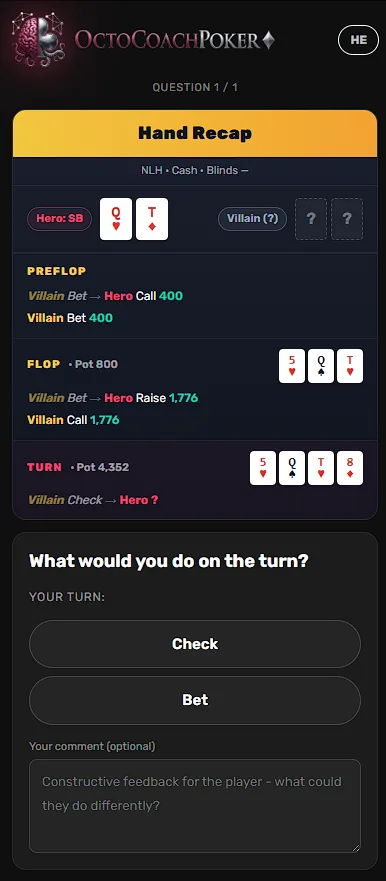
A hand poll in OctoCoach: voters see the action up to the decision, the opponent’s cards stay hidden, and they answer before they know how the hand ended.
Key takeaways
- Results-oriented thinking (“resulting”) means grading a decision by how it turned out.
- Outcome bias research shows people rate identical decisions better when they end well.
- In one hand, the result is mostly variance; the decision is the part you control.
- Review hands with the result hidden, street by street, using only what you knew.
- Write down the opponent’s range before you look at the showdown to beat hindsight bias.
- Results become a fair judge only over large samples.
The hand is over the moment the money goes in. What you take from it is still your decision. Grade the choice, not the card, and your game gets better even on the nights your bankroll does not.
OctoCoach is a mental game coach for the whole session cycle: prepare before you play, check in at breaks, and review afterward with a coach that knows your history. Start free, 7 days, no credit card. Related: how to review a poker session, how to get feedback on a poker hand, and how to deal with bad beats.