
How Do You Set a Budget for a Poker Trip or Series?
Set one number before you leave: the most you are willing to lose at the tables across the whole trip, every re-entry included. Keep flights, hotel and food as a separate line so you see what the trip really costs, decide at home what you will do if the money runs out early, and check the number before every session, not at the end of the trip.
Disclosure: OctoCoach is our product. The method below works with a notebook or a spreadsheet; the screens described are how OctoCoach implements it.
TL;DR
- One loss limit for the whole trip, decided at home, before the first session.
- Count every bullet: a $600 event you expect to fire twice costs $1,200.
- Keep travel costs as a separate line, but look at it: at small buy-ins, hotel and travel can cost as much as the buy-ins.
- Decide your plan B before you go: cheaper events, satellites, smaller cash games, or stopping.
- Check the number before every session and every rebuy. A limit you only add up at the airport does not stop anything.
How big should a poker trip budget be?
Size it from your bankroll, not from the schedule. Most tournament bankroll advice starts at about 100 buy-ins for the level you play, and the trip budget is the part of that roll you are willing to lose this week. A practical floor for an amateur is enough for four or five tournaments plus satellites; if you would need a card or an ATM to keep playing, the trip is too big.
“You should have 100 buyins for any tournament you play,” as Doug Polk puts it (Upswing), though PokerNews notes that many recreational tournament players end up with 60 buy-ins or less (PokerNews). For a series, Steve Zolotow’s minimum for an amateur is enough to buy into four or five tournaments of your choice, plus satellites (Card Player). Ashley Adams plans a trip around one or two major tournaments and reminds players to figure in travel, accommodations and food (PokerNews).
There are two ways to write the number. A cap on total buy-ins is the strictest: every buy-in, rebuy and re-entry counts, wins or not. A cap on net loss lets a tournament cash or a winning cash game buy you more play, as long as the trip as a whole is never down more than the limit. Either works if you pick it before you leave. What does not work is raising the limit after a win.
An example trip to a summer series, with a $3,000 net loss limit:
| Day | What | Result |
|---|---|---|
| 1 | $600 event, two bullets, no cash | -$1,200 |
| 2 | 2/5 cash game | -$650 |
| 3 | $300 event, cashed for $750 | +$450 |
| 4 | 2/5 cash game | -$1,050 |
| Net | about 82% of $3,000 | -$2,450 |
Example data.
After four days, $550 of the poker budget is left. That is the moment the plan B matters: one more $300 event, a couple of satellites, or a smaller cash game, and not a third bullet at the $600 level.
Do re-entries come out of the same budget?
Yes. Decide how many bullets you will fire in each event before the trip, and count all of them in the budget. As the WPT Global Blog puts it, in a passage PokerNews quoted, “A $1,100 event is not a $1,100 event if you are treating it as a likely two-bullet tournament.”
Re-entry events make the plan more important, not less: the second bullet is easiest to fire right after the first one busts, which is exactly when the decision is worst. In a tournament the money is committed the moment you pay it, and you cannot leave with part of it the way you can in a cash game, so count a buy-in as spent from the moment you register. A planned bullet count per event turns “should I fire again?” into a question you already answered at home, and the WPT Global Blog, quoted in the same PokerNews piece, advises treating every bullet “like a fresh investment, not a rescue mission.”
What about flights, hotel and food?
Keep them as their own line, next to the poker budget rather than inside it, and look at both together. At small buy-ins the trip can cost as much as the poker: at £200 to £500 events, hotel and travel can be “as much or more than the buy-in,” as Barry Carter wrote for PokerStrategy.
The poker limit protects your roll; the expenses line tells you what the trip really cost. In the example, a $900 flight, $1,100 of hotel, $350 of food and $120 of local transport add $2,470, so a trip that is $2,450 down at the tables cost $4,920 in all. “The bottom line is the bottom line, which includes all of your expenses,” as tournament pro Ari Engel put it (PokerNews).
Two smaller costs belong in the plan too. Rake is already inside the buy-in, but it takes a bigger share at small buy-ins: at the 2025 WSOP it was 17% at the $500 level against 11.5% at $1,500 (Covers). And tipping the dealers when you cash in a tournament is customary: about $10 to $20 on a min-cash, and 2 to 5% of the prize if you win the event (PokerNews).
How do you stick to a trip budget?
Write the rules at home, while you are calm: the limit, the bullets per event, and what you do if the money runs out early. Then make the number visible before every new session and every rebuy, because the moment you most want to break the limit is right after a loss.
- No refills. Ashley Adams never uses “an ATM or credit card to supplement” his playing funds on a trip, and suggests deciding, while you plan, what you would do after an early bust: another satellite, an inexpensive bracelet event, buying straight into the big event, or the cheaper daily deepstacks (PokerNews).
- Spread it over the trip. The budget should still exist on the last day. If day one costs half of it, the rest of the plan shrinks; nothing refills it.
- Results change how the next gamble looks. Classic research found that after a loss, a chance to get back to even is especially attractive, and after a win, money feels like “house money” and gets risked more freely (Thaler and Johnson, 1990). Both pull you past a limit you set calmly. Chasing losses covers the first trap and the poker stop-loss covers the session level.
Set a trip budget in OctoCoach (free)
How do you track a trip budget on your phone?
Start the trip in your tracker before the first session, with its budget, and let every session count against it. In OctoCoach, the trip card on Home shows how much of the budget your net loss has used, turns yellow at 80% and red at 100%, and once the budget is used up it asks you to confirm before another session or rebuy. Trips are free.
In OctoCoach you start a trip from Home, between sessions, with Start a trip: an optional name, the budget (“the most you’re willing to be down across the whole trip”), the currency (shekels, dollars or euros) and an optional end date. One trip is active at a time, and it ends when you tap End trip. Every session you start while the trip is active joins it automatically; a past session you log later does not.
The meter counts net loss. A finished session counts by its result; during a live cash session it uses your latest stack check-in, or the hands you logged if you have not checked in; a tournament counts as a loss of everything you paid in (buy-in, re-entries and rebuys) until its result comes in. Wins offset losses, but never raise the cap. Once the budget is 100% used, starting another session, or adding a rebuy, a re-entry or a table mid-session, first asks you to confirm. It is a pause to decide on purpose, not a block.
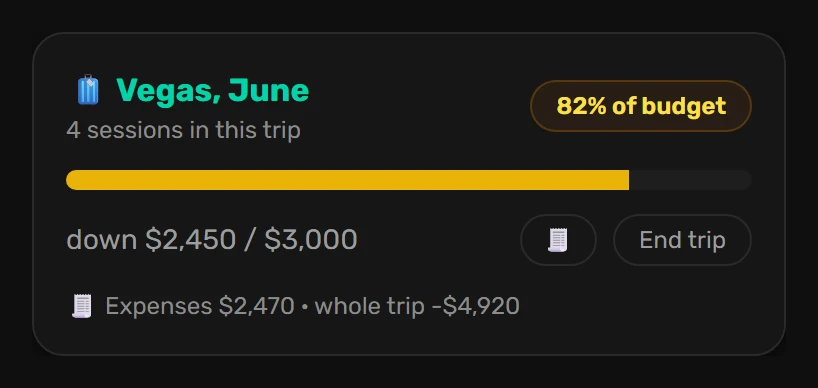
The trip card on Home, with the example trip from the table above.
While the trip is active, the receipt button on the card adds expenses (flight, hotel, food, transport or other, each in its own currency). They never count toward the meter; the card shows one line with the expenses and the whole trip’s result. In History, each trip gets its own card with its sessions, and the Analytics breakdown can group your results by trip, including profit per hour. With Pro, the AI coach knows your trip budget and coaches to your number.
OctoCoach is a coaching and session-journaling tool; it does not host games, take deposits, or involve real money. Trips, session and hand logging, and History with its profit per hour and breakdown are free. Pro adds the AI coach, hand analysis, voice, the bankroll advisor, the shot planner and Mental x Money analytics, for $12/month after a 7-day free trial.
Key takeaways
- Set one loss limit for the whole trip at home, and never raise it after a win.
- Count every planned bullet in the budget; a buy-in is spent the moment you pay it.
- Keep flights, hotel and food as a separate line, and add it to the poker result to see what the trip cost.
- Decide plan B before you go, so an early bust leads to a cheaper plan, not a refill.
- Check the number before every session and rebuy, not at the end of the trip.
Know where your trip budget stands before every session: OctoCoach, 7 days free, no credit card. Related: how to prepare for a poker series.