
How Do You Settle Up a Home Poker Game?
Write down every buy-in during the night. At the end, count every stack and check that the total equals the money that went in. Each player’s result is what they finished with minus what they put in. Then the biggest loser pays the biggest winner, and you repeat until everyone is square: never more than one payment fewer than the number of players.
Disclosure: OctoCoach is our product. Everything below works with a notebook and a calculator; the screens described are how OctoCoach does it.
TL;DR
- One person keeps the list: every buy-in and rebuy, the moment it happens, written down.
- Before anyone pays anyone, the counted stacks must add up to the money in. If they don’t, find out why, then decide together who takes the difference.
- Result = what you finished with minus what you put in. The results always add up to zero.
- Settle by matching the biggest loser with the biggest winner: six players need at most five payments, often fewer.
- Decide before the first hand: cash into a box or credit, what a chip is worth, and how many rebuys you allow yourself.
How do you settle up a home poker game?
Three steps: total what each player put in, count what each player has at the end, and subtract. The difference is each player’s result, and the results of all players add up to exactly zero. Losers then pay winners, matched so the table makes as few payments as possible.
The step that makes the end of the night easy happens at the start: one person keeps the list. Steve Blay, writing about hosting a home game for Advanced Poker Training, suggests the banker start a new page each night and “mark down the participants (nickname only if privacy is a concern), buy-in amounts and any rebuys, and amount they cashed out at the end of the night if any” (Advanced Poker Training). In a cash game, a stack is worth exactly the money its chips stand for; that is the difference from a tournament, where, as PokerNews puts it, the starting stack is 10,000, not $10,000 (PokerNews).
An example night: six players, $50 buy-ins, everyone plays on credit and settles at the end.
| Player | Put in | Finished with | Result |
|---|---|---|---|
| Dan | $50 (1 buy-in) | $170 | +$120 |
| Maya | $100 (2) | $170 | +$70 |
| Tom | $50 (1) | $80 | +$30 |
| Ben | $50 (1) | $60 | +$10 |
| Avi | $100 (2) | $20 | -$80 |
| Noa | $150 (3) | $0 | -$150 |
| Total | $500 | $500 | $0 |
Example data.
The count matches ($500 in, $500 counted), so the night can be settled. Two players lost $230 between them and four players won the same $230.
How do you work out who pays whom with the fewest payments?
Take the player who lost the most and have them pay the player who won the most, as much as one of them needs. Cross off whoever is now square and repeat. This greedy method never needs more than one payment fewer than the number of players, so six players need five payments at most.
In the example: Noa pays Dan $120, Avi pays Maya $70, Noa pays Tom $30, and Avi pays Ben $10. Four payments settle the whole table, where “every loser pays a pot and the pot pays every winner” would take six.
The “one fewer than the number of players” ceiling is a known result: any group of n people can clear its debts with at most n minus 1 payments. Finding the absolute minimum every time is much harder; Pătcaş and Bartha describe the debts’ clearing problem as “NP-hard in the strong sense” (arXiv), which in practice means the greedy method is what tables and apps use. It is the same idea as Splitwise’s “simplify debts”: “if Anna owes Bob, and Bob owes Cathy, then Anna can just pay back Cathy directly” (Splitwise).
Rounding helps at a real table. Nobody wants to transfer $23.47, so round each result to $1, $5 or $10, and give the few dollars of rounding difference to one player, say the player with the biggest result or the host, so the payments still add up exactly.
Settle your next home game in OctoCoach (free)
What do you do when the chip count doesn’t match the money?
Stop before anyone pays. Recount the stacks, then check the list for a rebuy that was never written down or a player who left with chips. If the gap is still there, the table decides: spread it across players by stack size, or give it to one player, for example the one who admits to a messy count.
Most gaps are honest: a miscounted stack, chips on the floor, a rebuy paid for in the kitchen and never recorded. Some are not. Blay warns that it is “just too tempting” for a losing player to sneak in an extra chip from home, and that the result is a box that comes up short while “everyone (including the offender) will look puzzled” (Advanced Poker Training). His fix is a chip set nobody else owns.
Here is what each option does. Say the example game sells 200 chips per $50 buy-in ($0.25 a chip), so 10 buy-ins put 2,000 chips in play, but one stack is miscounted and the final count is 1,960. Forty chips, $10, are missing from the count, which means $10 more went in than the stacks account for.
- Spread it by stack size. Every stack gets scaled up by the same factor ($500 / $490), so Dan’s $170 becomes about $173.47 and Noa’s empty stack stays empty. Nobody is singled out; the players who have more chips get more of the gap.
- Give it to one player. All $10 goes to one player’s stack, or part of it, with the rest spread by stack size.
- When the count is over, more chips than were sold, the same two choices work in reverse: shrink every stack by the same factor, or charge the extra to one player.
How much is a chip worth in a home cash game?
Decide it before the first hand: either a fixed value (“one chip is $0.25”) or a number of chips per buy-in (“200 chips for $50”). A cash-game stack is worth exactly what its chips stand for, so the value has to be clear to everyone before anyone counts.
PokerNews suggests giving each player chips worth exactly the buy-in, split across denominations: for a $100 buy-in, 80 chips of $0.25, 40 of $0.50, 20 of $1, 10 of $2 and 4 of $5 (PokerNews). With mixed colors, count each stack in money, not in chips.
When every chip is the same, there is a third way: skip the value and work it out at the end, total money in divided by total chips counted. With 1,960 chips counted for $500, one chip is worth about $0.255. That rate also spreads any miscount across players by stack size automatically, and it gives the same result as spreading the gap by stack size.
Should a home game use a cash box or credit?
A cash box is simpler and safer: everyone pays for chips in cash, a player who leaves early is paid from the box, and at the end the box pays out each stack, so nobody owes anybody. Credit is easier to start but harder to finish: debts pile up, and losing players find it easier to lose track of how much they owe.
Blay’s banker is “the only person who touches” the cash box and the chips (Advanced Poker Training). Robert’s Rules of Poker, in its edition for private games, keeps money off the felt: “All cash should be changed into chips in order to play” (Robert’s Rules of Poker).
Run the example night with cash instead of credit. All $500 goes into the box as it is bought. Avi leaves at 11:30 with $20 in chips and gets $20 from the box, which now should hold $480. At the end the box pays Dan $170, Maya $170, Tom $80 and Ben $60: $480, and the box is empty. Nobody transfers anything to anybody.
Credit works between friends who trust each other, but it is a different game psychologically. Greg Raymer, writing for Card Player about private online games that settle up later, puts it plainly: “It is very easy to lose track of just how much you have lost” (Card Player). His suggestion, pre-funding your play, is the box by another name. Many games mix the two: most pay cash, and one regular plays on credit. That works, as long as the list records which buy-in was which.
Can the host take a cut at a home game?
Check your local law first. In many places a private game is legal only while nobody profits from running it, and a cut of the pots, of the winnings or a per-player fee can change that. If the host buys food and drinks, split what it actually cost, like any dinner with friends, and keep it out of the poker results.
In the UK, domestic gaming needs no permission only if, among other conditions, “no charge or levy is made for playing”. The Gambling Commission adds that “no charge (by whatever name called) is made for participation”, and, citing the Act, treats “a deduction from or levy on sums staked or won” as exactly such a charge, “whether the charge is expressed to be voluntary or compulsory” (Gambling Commission). For the US, Robert’s Rules of Poker notes that “Raking pots and charging an hourly rate for playing are two examples of activities only a licensed commercial cardroom would be allowed to do” (Robert’s Rules of Poker). This is general information, not legal advice; the rules differ by country and state.
Whatever you split for food and drinks, keep it separate from the results. A contribution to the snacks is not a poker loss, and it should not make the night look worse than it was in anyone’s records.
How do you keep a home game from costing more than you planned?
Decide your limit before the game, not after the third rebuy: how many buy-ins you will take, or the most you are willing to lose tonight. Home games make chasing easy, because the rebuy is one sentence to a friend away, and on credit it doesn’t even feel like money.
Raymer describes the trap from the player’s side: “You keep texting the organizer to give you another $100, and then at the end of the week, you find out you lost much more than you realized” (Card Player). Research on gamblers describes chasing losses, playing on to win back what you lost, as a core feature of problem gambling (Edson et al., 2025). A friendly game doesn’t make it go away; the friendliness makes “one more” easier to say.
- Set the number at home. Two buy-ins, three, whatever fits your bankroll, and the same discipline as a stop-loss at a casino.
- Pay cash if you chase. Handing over money is a pause. Credit removes it.
- Count the night honestly. A home game is real money. If it doesn’t go into your results, a losing month of Thursday games stays invisible. See how to track live sessions.
- The needle is still tilt. Friends know exactly which buttons to push, and a needle from across the kitchen table can start the same tilt as a bad beat.
How do you run a home game on your phone?
Open a home game, add the players by first name or nickname, and tap a button for every buy-in. At the end, enter each stack in chips or money; the app checks the count against the money in, and lists who pays whom in as few payments as it can. In OctoCoach the home game manager is free.
In OctoCoach you start from Home with 🏠 Home game. Setup takes the buy-in, the currency, what players count at the end (chips or money) and the chip value, which can be “1 chip =”, chips per buy-in, or worked out at the end from the money in. Buy-ins are paid in cash into the box or on credit, and you can switch any single buy-in between the two. A player can come in for any amount: one big + repeats their last buy-in and payment, and Other takes any other amount. A player who leaves early is cashed out on the spot, and the stack pays their own credit first: leaving with $200 and $100 on credit means taking $100, and tapping Paid from the box fills that in.
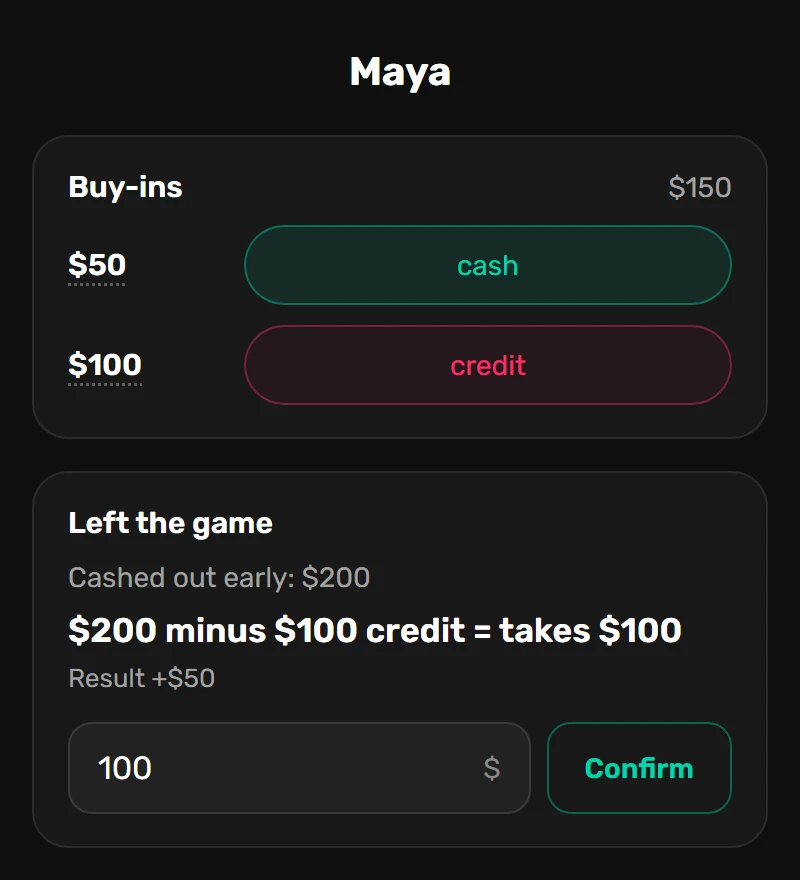
The stack pays the credit first, and the box pays what is left. A separate example from the night in the table. Example data.
At the end, Game over: count the stacks. The app shows whether the count matches the money in; if it doesn’t, settling waits until you fix it or choose: spread the gap by stack size, or give all or part of it to one player. Then Who pays whom lists the payments, with the box as one more party when buy-ins were cash, and the results under it.
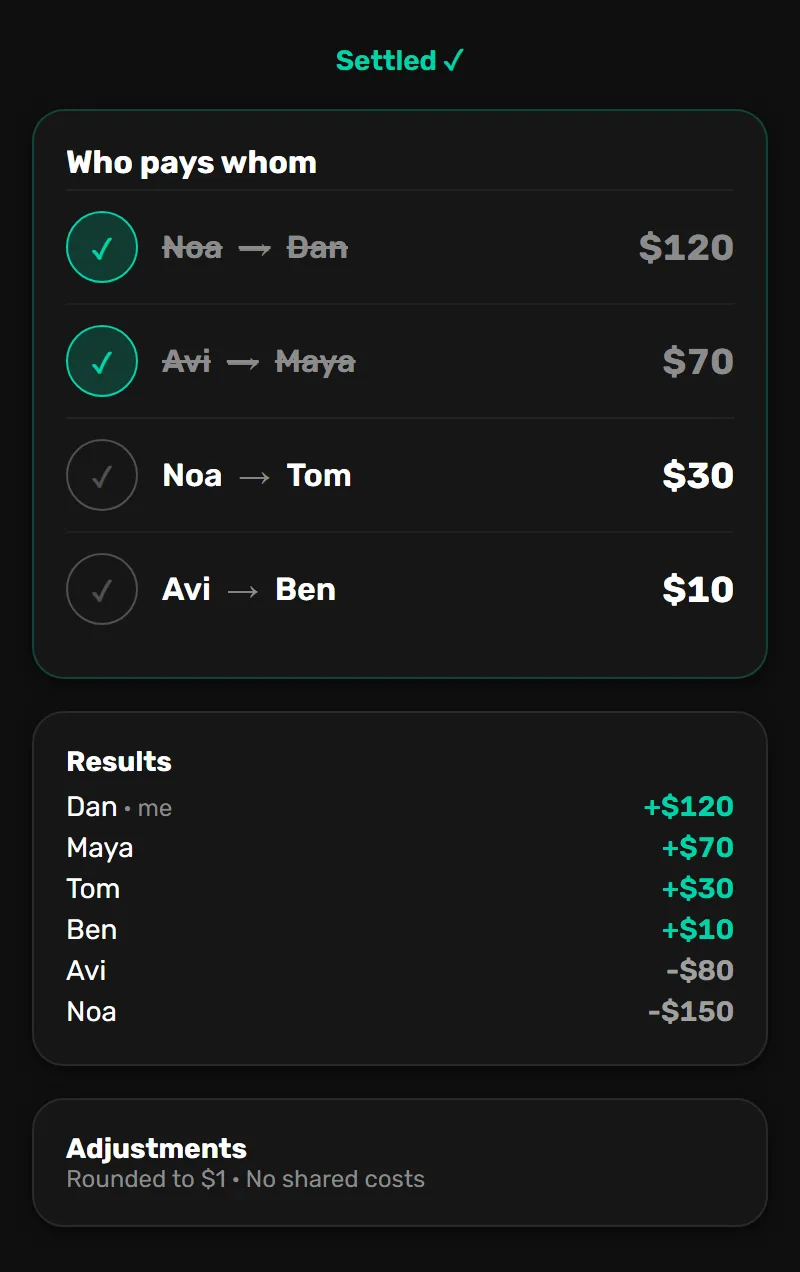
The settle-up screen with the example night from the table above. Example data.
Adjustments round the payments to 1, 10, 100 or any step you choose, with the rounding difference shown and given to the biggest result or to you, and split what one player spent on food and drinks equally among everyone, that player included, leaving out anyone marked as having paid separately. Each payment gets a ✓ once it is paid. Share sends the whole settle-up as text to WhatsApp or any app.
For the table, Summary link for the table creates a public link anyone can open without signing in: who is in for how much and what should be in the box, updated live, and at the end who pays whom, with the paid marks. It shows only the names and amounts you entered, and you can turn it off.
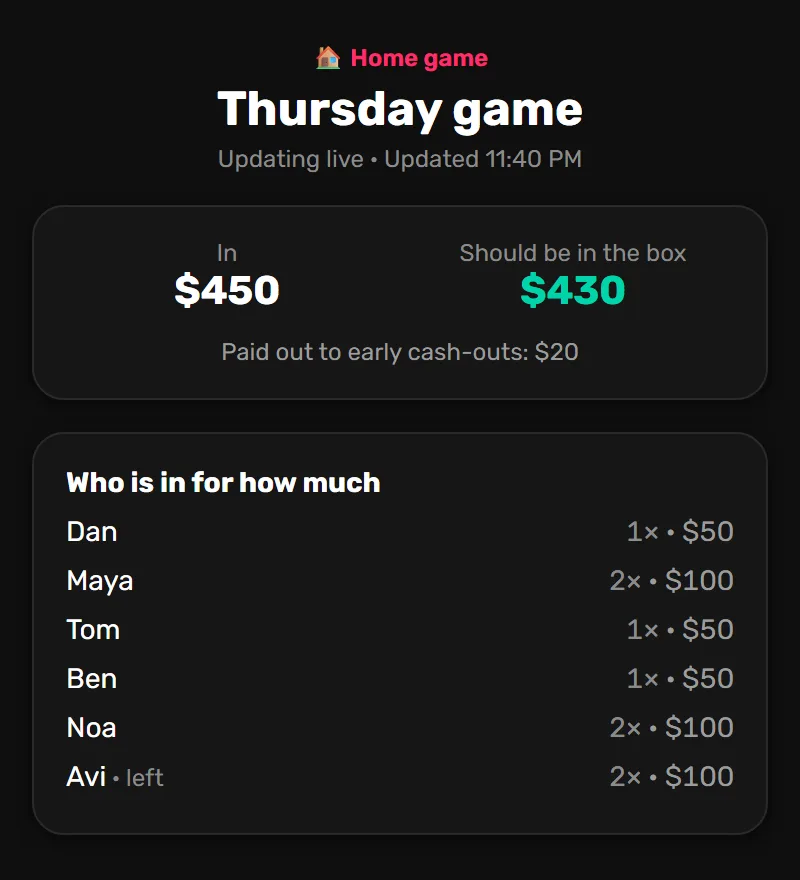
The summary link for the cash-box version of the same night, after Avi cashed out from the box and before Noa’s third buy-in. Example data.
If you played, your own result can go straight into History and your bankroll as a home cash session, at its exact amount rather than the rounded payment. With a live session running that night, the session wins: while it is live the game does not save a second result, and you can link the two. Hand off management passes the game to someone else with a one-time link, and Same as last time fills in next week’s players and settings.
OctoCoach is a coaching and session-journaling tool; it does not host games, take deposits, or involve real money. The home game manager, session and hand logging, and History are free. Pro adds the AI coach, hand analysis, voice, the bankroll advisor, the shot planner and Mental x Money analytics, for $12/month after a 7-day free trial.
Key takeaways
- Write down every buy-in the moment it happens; the list is the whole settle-up.
- Check that the count matches the money in before anyone pays anyone.
- Results add up to zero; biggest loser pays biggest winner, at most one payment fewer than the number of players.
- Agree on the chip value, cash or credit, and how food and drink costs are split before the first hand.
- Set your own rebuy limit at home, and count home games in your results like any other session.
Run your next home game from your phone: OctoCoach, free to start. Related: chasing losses in poker, home poker game apps compared.